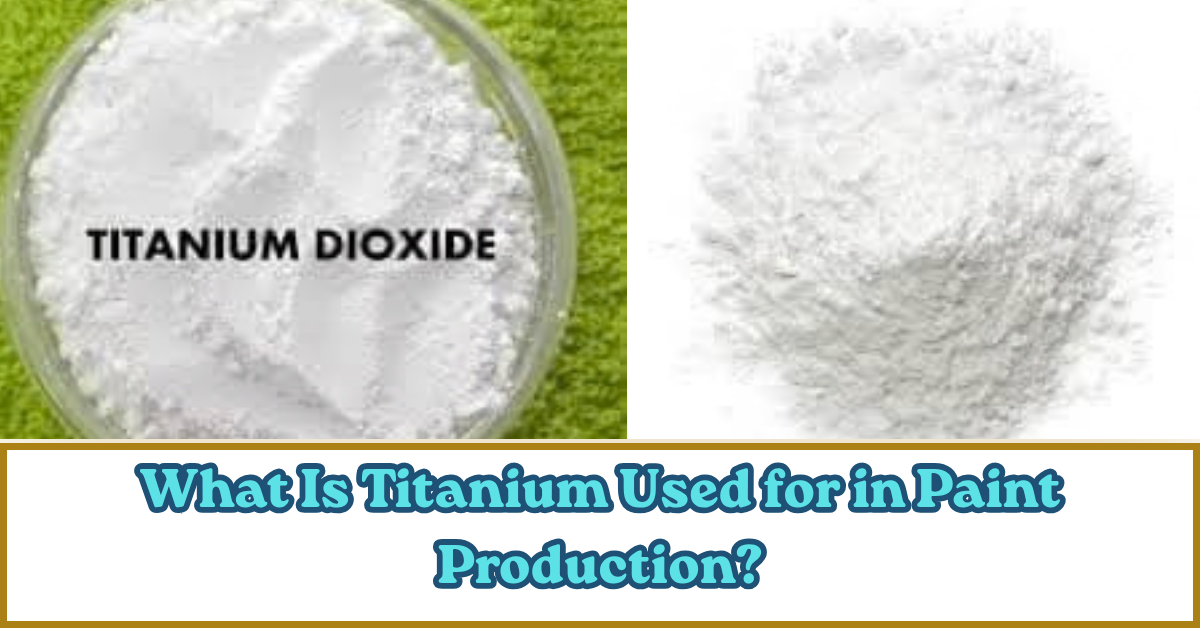
Titanium dioxide is one of the most important raw materials or pigment used in the production of white and light-coloured paints. It is commonly added to paint formulations because it provides whiteness, coverage, hiding power and brightness, helping the paint cover the surface underneath very well.
For paint producers, understanding what titanium does is important because the amount and quality of titanium dioxide used can directly affect the appearance, coverage and quality of the paint.
If you have ever noticed that one paint covers a wall with fewer coats while another requires several coats, the formulation and the quality of its raw materials are among the factors that can make a difference. Also see: What Is Texanol Used for in Paint Production?
This article explains what titanium dioxide is, what it does in paint production, how it affects coverage, and what can happen when too little or too much is used.
What Is Titanium Dioxide?
Titanium dioxide, commonly written as Titan, is a white pigment widely used in paints, coatings and other products where high whiteness and coverage are required.
In paint production, titanium dioxide is used primarily as a white pigment. Unlike many ordinary fillers, it has a very high ability to scatter visible light. This makes the paint have coverage and helps prevent the colour of the underlying surface from showing through easily.
Titanium dioxide is available in different grades and qualities. Paint manufacturers normally select a grade according to the type of paint being produced and the quality required from each production.
What Is Titanium Used for in Paint Production?
The main purpose of titanium dioxide in paint production is to give the paint coverage, brightness and hiding power.
These properties are closely related but are not exactly the same.
1. Titanium gives Paint hiding power (Coverage)
One of the major reasons titanium dioxide is used in paint is to give coverage.
Coverage refers to the ability of paint to cover the surface underneath it. A paint with good hiding power can conceal the previous wall colour more effectively.
For example, when applying white paint over a darker surface, a properly formulated paint containing an appropriate level of titanium dioxide can reduce the amount of the original colour that remains visible.
2. Titanium Increases Paint Opacity or shinning
Opacity is the ability of a coating to prevent light from passing through it and to hide the surface beneath it.
Titanium dioxide is highly effective at scattering light (shinning). This is one reason it is widely used because it helps paint glitter.
When the pigment is properly dissolved throughout the paint, it helps the coating form a more uniform and opaque layer on the wall. Also see: What Is Acrylic Gum Used for in Paint Production?
3. Titanium Makes Paint Whiter (for white colour paint)
Titanium dioxide contributes significantly to the white appearance of paint.
A properly formulated white paint should have a clean and consistent appearance. The quality of the titanium dioxide and the overall formulation can influence how bright and white the final product appears.
This is why simply adding a large quantity of ordinary white filler does not necessarily produce the same result as using a suitable white pigment.
4. Titanium Improves Hiding Power
Hiding power is closely connected to opacity and coverage.
A paint with good hiding power can cover the colour or appearance of the surface below it without requiring excessive coats.
Titanium dioxide is particularly valuable because of its strong light-scattering ability. When the pigment particles are properly distributed in the coating, they help reduce the amount of light that reaches and reflects from the underlying surface.
5. Titanium Helps Produce Brighter Paint Colours
Titanium dioxide is not only useful in white paint.
It is also used in many light-coloured paint formulations because it provides a strong white base. When colourants are added, the titanium-containing base can help produce clean and bright shades.
However, the amount of titanium required depends on the desired colour, paint type and formulation. See: Why Is My Paint Not Covering Well? 9 Causes and How to Fix It
Conclusion
Titanium dioxide is one of the most important white pigments used in paint production. Its major functions include improving whiteness, opacity, hiding power and coverage.
However, good paint production is not simply about adding more titanium dioxide. The pigment must be selected appropriately, properly dissolved and balanced with the other materials in the formulation.
If your paint is not covering well, titanium dioxide may be one of the things to investigate.
For anyone entering commercial paint production, learning how to quantify and balance raw materials is important. Understanding the role of each material makes it easier to produce consistent paint, control production costs and avoid unnecessary trial and error. Also see: Why Is My Satin Paint Not Shining? 4 Chemicals That Improve Its Gloss
FAQs
1. What is the main purpose of titanium dioxide in paint?
The main purpose of titanium dioxide is to provide whiteness, shine, coverage and hiding power. It helps paint cover the surface underneath and contributes to the brightness of white and light-coloured coatings.
2. Does titanium make paint thicker?
Not necessarily. Titanium dioxide is primarily a pigment, not simply a thickening chemical. The thickness of paint is controlled by the overall formulation, including the binder, solids and other ingredients.
3. Does titanium improve paint coverage?
Yes. Titanium dioxide can significantly improve hiding power and coverage because of its strong ability to scatter visible light.
4. What happens if there is too little titanium dioxide in paint?
The paint may have reduced coverage and hiding power. It may require more coats and may not cover darker surfaces effectively.
5. Is titanium dioxide used in emulsion paint?
Yes. Titanium dioxide is commonly used in white and light-coloured emulsion and other architectural coatings to provide whiteness and coverage.
6. Can I replace titanium dioxide with ordinary white filler?
Not as a direct one-for-one replacement. Titanium dioxide is a high-performance white pigment with strong light-scattering properties, while fillers and extenders have different functions and performance characteristics.
7. Is more titanium dioxide always better?
No. Excessive use can increase production costs without providing a proportional improvement in paint performance. The correct level depends on the complete formulation and desired product quality. see more

I am Godwin Zion With over 18 years of hands-on experience in construction finishing, I help organizations, entrepreneurs, vocational institutions, and development programs build practical skills that create jobs, improve quality, and support sustainable businesses.
My expertise combines technical knowledge with practical field experience in paint production, POP ceiling installation, wall preparation, decorative finishing, and construction finishing. I have trained aspiring entrepreneurs, skilled artisans, and business owners to produce high-quality paints, deliver professional finishing services, and build profitable businesses.
I believe practical skills create economic opportunities. My mission is to equip individuals and organizations with the knowledge, systems, and confidence to succeed in the construction finishing industry across Africa.