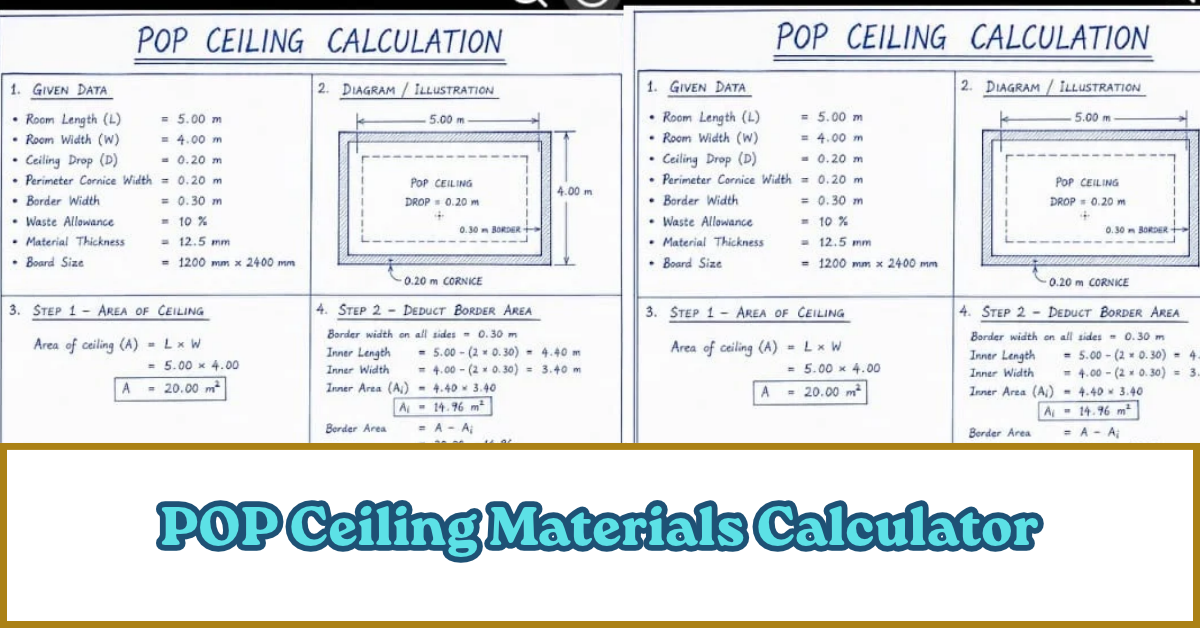
Are you planning to install a POP ceiling in your bedroom, living room, hall, or an entire building? One of the first questions you need to answer is how many bags of POP cement and how many Kg of sponge or fibre the work will require.
Our POP Ceiling Materials Calculator helps homeowners, POP installers, building contractors, and property developers estimate POP cement quantities based on the measured ceiling area.
Enter your room length and width in metres, or enter the ceiling area directly. The calculator uses an estimated coverage rate of 2.3 square metres per bag of POP cement, before allowance.
Calculate your POP ceiling materials below.
Calculate Your POP Ceiling Materials
Enter your ceiling dimensions or measured area. Estimates use 2.3 m² per bag of POP cement and 2.5 m² per kg of POP fibre (sponge), before allowance.
This estimates POP cement for a flat ceiling. Decorative details, bulkheads and drops can increase consumption.
Fibre is measured in kilograms, not packs. Purchase at least the calculated weight; actual packaging may require rounding up to the next available pack size.
Calculation assumptions
POP cement: 1 bag per 2.3 m², before allowance. POP fibre (sponge): 1 kg per 2.5 m², before allowance. The selected allowance applies once to both materials. Cement bags are rounded up to whole bags. Fibre is reported by weight (kg), rounded up to two decimal places, without assuming a pack size. Estimates are for flat ceiling area; additional drops and details must be measured separately.
How Many Bags of POP Cement Do I Need?
The number of bags depends on the ceiling area and the amount of material used per square metre.
Using a practical estimate of one bag per 2.3 m²:
POP cement bags = Ceiling area ÷ 2.3
For example, a ceiling measuring 40 m² requires:
40 ÷ 2.3 = 17.39 bags before allowance
Adding a 10% allowance:
17.39 × 1.10 = 19.13 bags
Rounded up, the estimated purchase quantity is 20 bags of POP cement.
This coverage rate is a field-based planning assumption. Actual consumption can differ with ceiling design, installation method, material quality, and wastage. Also see: How Many Bags of POP Cement Do I Need for a Room?
How to Use the POP Ceiling Materials Calculator
Step 1: Measure your ceiling
Measure the length and width of the room in metres. For a rectangular room, multiply these dimensions to calculate the ceiling area.
Step 2: Enter the dimensions
Enter the length and width into the calculator. Alternatively, select the option to enter the known ceiling area directly.
Step 3: Select a material allowance
The calculator starts with a 10% allowance, which you can adjust depending on the project.
Step 4: Review your material estimate
The result shows the ceiling area, the estimated bags before allowance, the adjusted quantity, and the whole number of POP cement bags to purchase.
POP Ceiling Materials Coverage Rate
The POP Ceiling Materials Calculator uses practical material coverage estimates to calculate how much POP cement and how many kg of fibre (POP sponge) a ceiling project may require.
The estimated coverage rates are:
| Material | Coverage before allowance |
|---|---|
| POP cement | 1 bag per 2.3 m² |
| POP sponge (fibre) | 1 kg per 2.5 m² |
How to Calculate POP Sponge (Fibre)
POP sponge is estimated by weight in kilograms.
Using a coverage rate of 2.5 m² per kilogram:
POP fibre required (kg) = Ceiling area (m²) ÷ 2.5
For a 40 m² ceiling:
40 ÷ 2.5 = 16 kg
Adding 10% allowance:
16 × 1.10 = 17.6 kg
Estimated quantity: 17.6 kg of POP sponge.
These estimates are intended for preliminary material planning. Complex POP ceiling designs, decorative drops, additional surfaces, and material wastage can affect the actual quantities required.
How to Calculate POP Ceiling Area
For a rectangular room:
Ceiling area = Room length × Room width
For example, a room measuring 4 metres by 3 metres has a ceiling area of:
4 × 3 = 12 m²
POP cement estimate:
12 ÷ 2.3 = 5.22 bags
With a 10% allowance:
5.22 × 1.10 = 5.74 bags
Rounded up, the estimated quantity is 6 bags.
For irregularly shaped rooms, divide the ceiling into smaller rectangles, calculate their areas separately, and add the results.
What Affects POP Ceiling Material Consumption?
Ceiling design: Flat ceilings generally require a simpler estimate than designs with multiple drops, curved edges, or detailed decorative elements. See How to Calculate POP Ceiling Materials and Labour Costs in Nigeria
Installation method: The thickness and construction technique can affect the amount of POP cement used.
Material handling: Mixing losses, breakage, and leftover material can increase the quantity required.
Site measurements: Incorrect room dimensions or failure to account for additional ceiling surfaces can lead to material shortages.
For complex projects, measure the actual surfaces and review the design with an experienced POP installer before ordering.
FAQs
1. How many bags of POP cement can cover 40 square metres?
Using one bag per 2.3 m², a 40 m² ceiling requires approximately 17.39 bags before allowance. With a 10% allowance, the estimated purchase quantity is 20 bags.
2. How many bags of POP do I need for a 12 by 12 room?
If the room dimensions are 12 feet by 12 feet, the ceiling area is approximately 13.38 m².
At 2.3 m² per bag, the base estimate is 5.82 bags. With a 10% allowance, the result is approximately 6.40 bags, rounded up to 7 bags.
3. Does POP ceiling design affect material quantity?
Yes. Decorative drops, curved features, additional edges, and complicated designs can increase the material requirement beyond a simple flat-ceiling estimate.
5. Can I calculate POP materials for an entire house?
Yes. Measure the ceiling area of each room, add the areas together, and enter the total. For complex designs, estimate additional surfaces separately.
Related POP Ceiling Articles
Continue planning your project with these resources from Paint Production Academy:
- How Much Does POP Ceiling Cost in Nigeria?
- POP Ceiling Materials List in Nigeria
- Modern POP Ceiling Design Ideas
- Why POP Ceilings Fall
- POP Ceiling Cost Per Square Metre
Conclusion
This POP Ceiling Materials Calculator provides an initial quantity estimate for project planning and budgeting. Before purchasing, confirm the ceiling measurements, material packaging, and installation requirements with the contractor handling the project. Also see our Paint Quantity Calculator