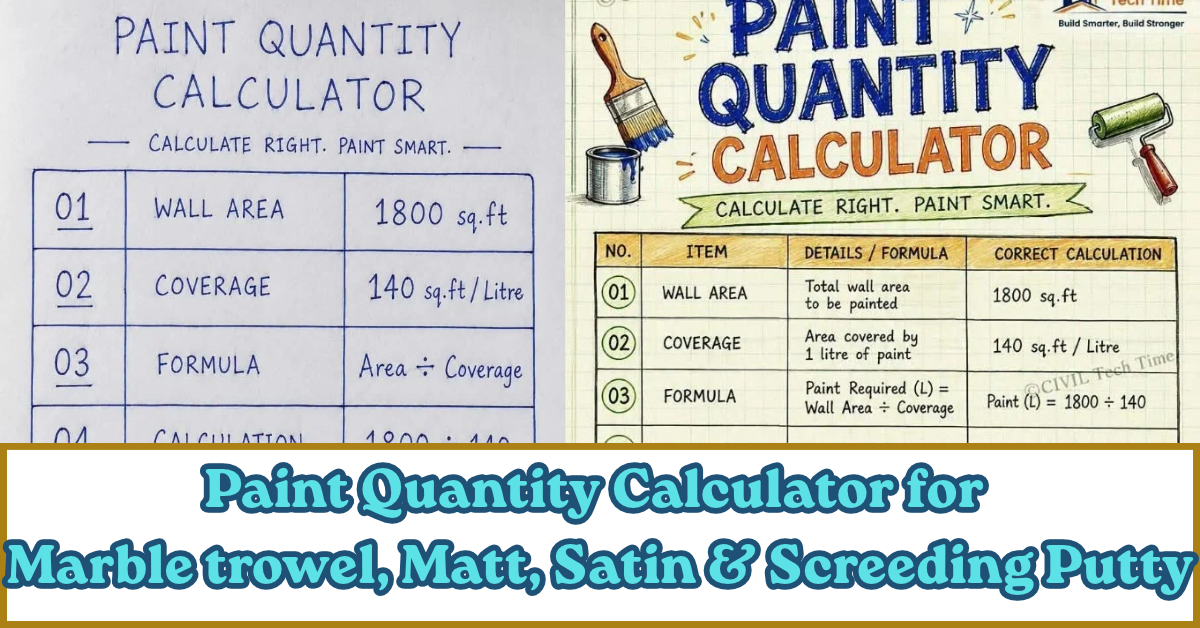
If you are Planning to paint a house, renovate a room, or screed newly plastered walls? Before buying materials, you need to know how much paint or wall-finishing product the job will require.
Our Paint Quantity Calculator helps homeowners, painters, contractors, and property developers estimate the amount of emulsion paint, matt paint, satin paint, screeding putty, or marble trowel needed for a project.
Simply enter your paintable wall area in square metres, select the material you want to calculate, and get an estimated quantity based on the product’s coverage rate.
The calculator also shows the material requirement with an additional 10% allowance to help account for minor wastage and application differences.
Use the paint calculator below to estimate your materials before purchasing.
How much Emulsion Paint do I need?
Enter your paintable wall area after subtracting doors and windows.
What this estimate assumes
Estimates are for planning. Product formulation, surface porosity, texture and application thickness affect actual use. Confirm the manufacturer's specification before purchasing.
Note: This calculator provides estimates, not guaranteed quantities. Actual consumption depends on the product formulation, surface condition, number of coats, application thickness, and application method. Confirm the coverage rate of the specific product you intend to use.
How to Calculate the Amount of Paint You Need
To calculate the quantity of paint required for a wall, you need three measurements:
- The total paintable surface area in square metres (m²).
- The number of coats you intend to apply.
- The coverage rate of the paint, usually expressed in square metres per litre (m²/L).
The basic formula is:
Paint required (litres) = Wall area (m²) × Number of coats ÷ Paint coverage (m²/L)
For example, suppose you want to apply two coats of satin paint to a wall area of 100 m².
If the paint covers 12 m² per litre per coat:
100 × 2 ÷ 12 = 16.67 litres
This means you need approximately 16.67 litres of paint before allowing for wastage.
Adding 10%:
16.67 × 1.10 = 18.33 litres
However, this estimate assumes that the selected paint actually achieves the stated coverage. Rough, porous, or poorly prepared surfaces may require more material.
How to Use This Paint Calculator
Our online calculator is designed to estimate paint and finishing materials without complicated manual calculations.
Step 1: Select the paint or wall-finishing material
Choose the product you intend to use from the calculator’s dropdown menu.
Available options include emulsion paint, matt paint, satin paint, screeding putty, and marble trowel.
Each product uses a different coverage assumption because these materials do not spread or build up on walls in the same way.
Step 2: Enter your paintable wall area
Measure the walls and enter the total area in square metres.
If your total wall measurement includes doors and windows, deduct those openings before entering the final figure.
For preliminary estimates, a standard door may be approximated as 2 m² and a window as 1.5 m². For more accurate results, measure the actual openings. Also see How to Calculate Paint Quantity for House
Step 3: Enter the number of coats where applicable
For emulsion, matt, and satin paint, enter the number of coats you intend to apply.
The calculator then estimates the quantity required and displays an additional allowance for wastage.
For screeding putty and marble trowel, the calculator uses the specified application coverage assumptions.
What This Paint Calculator Can Estimate
The calculator supports five commonly used painting and wall-finishing materials.
1. Emulsion Paint Calculator
Emulsion paint is widely used for painting interior walls and ceilings. The amount required depends on the total wall area, number of coats, surface porosity, and paint formulation.
Based on practical painting experience, two 20-litre drums of emulsion paint can cover approximately 40 m² of wall surface with two coats, including a material allowance.
Coverage calculation:
2 drums × 20 litres = 40 litres
40 m² ÷ 40 litres = 1 m²/L for the complete two-coat application
Expressed as a per-coat coverage rate:
40 m² × 2 coats ÷ 40 litres = 2 m²/L per coat
This gives an effective coverage rate of 2 m² per litre per coat, including allowance.
Formula:
Emulsion Paint Required (litres) = Wall Area (m²) × Number of Coats ÷ 2
Example: For a 40 m² wall surface requiring two coats
40 × 2 ÷ 2 = 40 litres
40 litres ÷ 20 litres per drum = 2 drums
Estimated quantity: 40 litres (2 drums), including allowance.
No additional 10% allowance is required because the observed coverage already includes a material allowance.
Actual paint consumption may vary depending on the paint formulation, wall texture, surface porosity, and application method.
2. Matt Paint Calculator
Matt paint produces a low-sheen finish and is commonly used on interior walls where a non-reflective appearance is preferred.
For this calculator, the matt paint estimate uses an assumed coverage of 8 m² per litre per coat.
For example, a 40 m² wall area requiring two coats would need:
40 × 2 ÷ 8 = 10 litres
With a 10% allowance:
10 × 1.10 = 11 litres
This is a planning estimate. The actual quantity may differ depending on the product and surface preparation. See How to Calculate Wall Screeding Materials and Labour cost Per Square Metre
3. Satin Paint Calculator
Satin paint has a noticeable sheen and can produce a smooth, reflective finish when applied correctly.
The calculator uses an assumed coverage of 12 m² per litre per coat for satin paint.
For example, two coats on 60 m² would require:
60 × 2 ÷ 12 = 10 litres
With a 10% allowance, the estimate becomes 11 litres.
For a satisfactory finish, the wall should be properly prepared, dry, and suitable for the chosen paint system. Poor preparation can affect both appearance and consumption.
4. Screeding Putty Calculator
Screeding putty is used to improve wall smoothness by filling minor surface imperfections and creating a uniform base for painting.
Unlike paint, putty consumption is generally calculated by weight in kilograms (kg).
Based on practical application measurements, three 25 kg buckets of screeding putty can cover approximately 40 m² of wall surface with two application passes, including a material allowance.
Coverage calculation:
3 buckets × 25 kg = 75 kg
40 m² ÷ 75 kg = 0.5333 m²/kg
This gives an effective coverage rate of approximately 0.5333 m² per kilogram for two application passes, including allowance.
Formula:
Screeding Putty Required (kg) = Wall Area (m²) × 75 ÷ 40
Example: For a 40 m² wall surface
40 × 75 ÷ 40 = 75 kg
75 kg ÷ 25 kg per bucket = 3 buckets
Estimated quantity: 75 kg (3 buckets), including allowance.
No additional 10% allowance is required because the field-tested coverage rate already accounts for material allowance.
Actual consumption may vary depending on wall roughness, application thickness, and surface preparation. Also see How to Calculate Wall Putty Production Materials for Any Batch Size
Deep hollows or uneven plaster may need separate repairs or levelling before normal putty application.
5. Marble Trowel Calculator
Marble trowel is a decorative wall-finishing material that creates a textured or polished decorative appearance, depending on the product and application technique.
The calculator assumes that 25 kg covers approximately 4 m², equivalent to 0.16 m² per kilogram.
For example, a 20 m² surface requires:
20 ÷ 0.16 = 125 kg
With a 10% allowance:
125 × 1.10 = 137.5 kg
If the product is supplied in 25 kg buckets:
137.5 ÷ 25 = 5.5 buckets
Since you cannot normally purchase half of a sealed bucket, the estimate rounds up to 6 buckets.
Always verify the product’s recommended application thickness and actual coverage before ordering.
FAQs
1. How much paint do I need for a 12 × 12 room?
A room measuring 12 feet by 12 feet has a floor area of approximately 13.38 m². However, the amount of wall paint required also depends on wall height, doors, windows, coverage, and number of coats.
Assuming the walls are 9 feet high, the combined area of the four walls is approximately 40.14 m² before deducting openings.
Measure your doors and windows, subtract their areas, and enter the remaining wall area into the calculator.
2. How many square metres can one litre of paint cover?
Coverage varies by product. Some paints may cover around 8–12 m² per litre per coat under suitable conditions, but this is not a universal rule.
Always refer to the manufacturer’s coverage specification for the particular paint being used.
3. How much paint is needed for two coats?
For the same wall area and coverage rate, two coats generally require twice the quantity of one coat.
For example, if one coat requires 5 litres, two coats will require approximately 10 litres before allowing for wastage.
4. How do I calculate paint quantity for a three-bedroom house?
Measure the wall area of each room, passage, and other surface to be painted.
Subtract the areas of doors and windows, then calculate each coating type separately.
A three-bedroom house may require different quantities of emulsion, matt, satin, and exterior paint depending on the chosen finishes.
5. Does wall screeding reduce paint consumption?
Properly prepared and sealed screeded walls can provide a more uniform surface for painting.
However, screeding alone does not guarantee lower paint consumption. The absorbency of the screeding material, the primer or sealer used, and the paint formulation all affect the final quantity required.
6. How many bags of putty do I need for a room?
First calculate the wall area in square metres. Then divide that area by the putty’s stated coverage in m²/kg to obtain the estimated weight.
Divide the resulting weight by the bag size and round up to whole bags, allowing for wastage where appropriate.
7. Should I add 10% extra paint?
A 10% allowance is a practical starting point for many estimates, but it is not sufficient for every project.
8. Can I use this calculator for exterior painting?
Yes, the area-based calculation can help estimate exterior paint quantities. However, use the coverage rate and coat recommendations for the actual exterior paint product.
Exterior surfaces may be rougher or more porous than interior walls, which can affect consumption.
Related Paint and Wall Finishing Articles
Accurate material estimation is only one part of planning a successful painting project. Surface preparation, product selection, and correct application are equally important.
Explore these additional resources from Paint Production Academy:
- How to Produce Matt Paint
- How to Produce Satin Paint
- Wall Screeding Materials
- Paint Prices in Nigeria
- How to Produce Wall Putty
Final Note
Estimating paint quantity before starting a project can help you prepare a more realistic budget, reduce unnecessary purchases, and avoid running short of materials during application.
Use the calculator to obtain an initial estimate, then confirm the manufacturer’s recommended coverage, application thickness, and packaging sizes before making your final purchase.
For larger projects, calculating each surface and coating system separately will generally produce a more reliable material schedule.