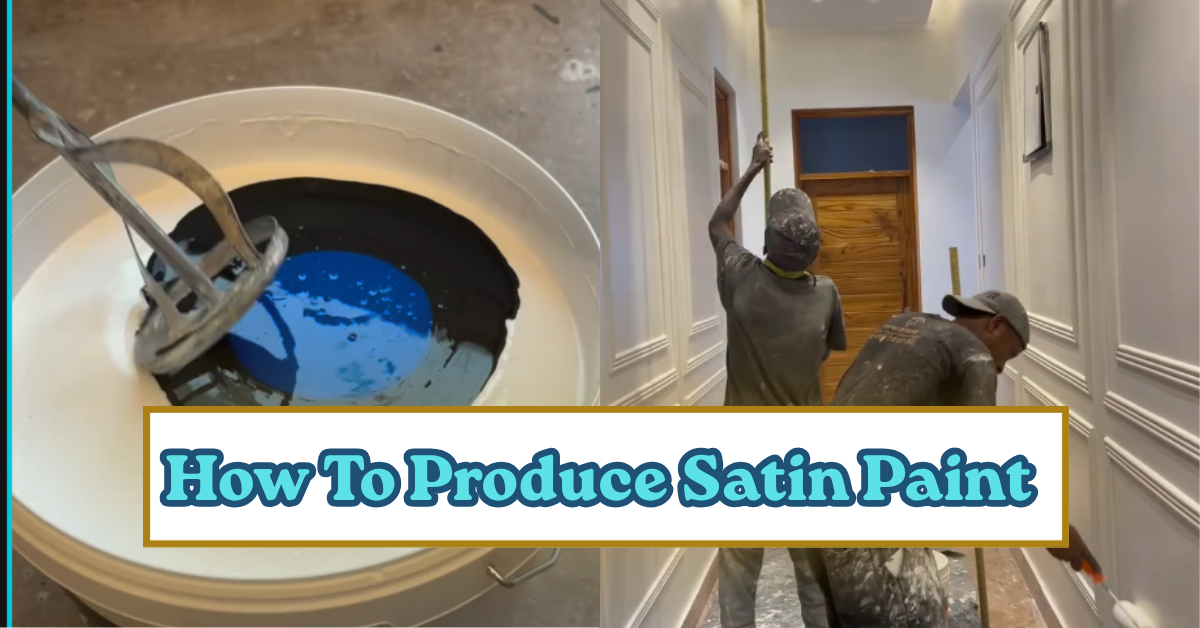
How To Produce High Quality Satin
Welcome to this practical session on how to produce high-quality satin paint. In this tutorial, you will learn the step-by-step process, systems, methods, and techniques used in producing durable satin paint, based on real industry experience.
Satin paint is one of the most popular decorative paints used for homes, offices, hotels, schools, and commercial buildings because of its smooth shiny appearance, durability, and washable finishing.
Many people want to learn satin paint production either to reduce painting costs, start a profitable paint business, or gain a valuable practical skill in the construction industry.
In this article, you will learn the chemicals used in satin paint production, the purpose of each chemical, and the correct process and method for producing quality satin paint that customers will love and people will recommend.
What Is Satin Paint?
Satin paint is a high quality decorative paint known for: Smooth shiny finishing, Strong wall coverage, Washable surface, Durability, and Professional appearance
Unlike ordinary emulsion paint, satin paint has stronger durability and better resistance against stains and weather conditions.
Chemicals Used In Satin Paint Production
The following chemicals is used when producing your satin paint: Calgon, Titan, Formaline, Genopol, Texanol, Hydrosol, Acrylic, Ammonia, Nitrosol (Thickener), Clean Water
Each chemical is a necessity and plays important role and in achieving quality satin paint.
Process Of Producing Satin Paint
Step 1: Apply Calgon
The first chemical to apply when producing satin paint is calgon.
What is the Purpose Of Calgon In Satin Paint production?
Calgon serves as an agent used to dissolve titan properly.
Without Calgon, it becomes difficult to dissolve titan smoothly, you use Calgon to dissolve titan without using Calgon to dissolve your titan the final paint quality may become poor.
To apply calgon:
Pour it into clean water
Stir properly
Ensure every particle dissolves completely
This stage is very important in achieving smooth paint production.
Step 2: Apply Titan
After you finish applying your calgon properly, the next chemical to apply is titan.
The Purpose Of Titan In Satin Paint
Titan gives the paint coverage.
please note, you have to stir your titan thoroughly until every particles is fully dissolve inside the water,
Titan is what allows a small quantity of paint to cover larger wall surface or areas effectively.
Many people wonder why some quality satin paints can cover an entire room using only a small quantity.
The reason is proper titan application.
Without enough titan, the paint may not spread properly or cover walls effectively, please take note of this.
Step 3: Apply Formaline
The next chemical to apply is formaline.
What is the Purpose Of Formaline In Paint Production
Formaline serves as a preservative agent. it is a very strong preservative agent in paint production and it is a necesity.
It helps the paint dry faster when applied on walls and also serves as an agent that give paint durability.
This allows painters to apply multiple coats more easily during painting projects.
Step 4: Apply Genopol
After formaline, the next chemical to apply is genopol.
The Purpose Of Genopol In Satin Paint
Genopol helps the paint move smoothly on the wall or ceiling when rolling or during painting application.
When rolling paint on walls, genopol helps create smooth and professional finishing.
It also serves as a preservative agent that prevents the paint from spoiling quickly.
Step 5: Apply Texanol
Texanol is another very important chemical used in satin paint production.
The Purpose Of Texanol In Satin Paint
Texanol helps: Improve paint durability, Texanol is also an agent that brings out the shinny finishing in satin, it also give paint a better smell, Improve paint preservation, Increase paint lifespan
Based on practical experience, many professional paint producers apply texanol twice during production for better results, keep following as i will explain why as we proceed..
Step 6: Apply Hydrosol
The next chemical to apply is hydrosol.
The Purpose Of Hydrosol In Satin Paint
Hydrosol is a preservative agent that gives the paint durability, it also give the paint a shinny finishing, it give the paint a good and attractive smell and also gives the Paint smoothness.
It is one of the important chemicals used in quality satin paint production.
Step 7: Apply Nitrosol (Thickener)
The next chemical to apply is nitrosol, also known as thickener.
The Purpose Of Thickener In Satin Paint
Thickener helps the paint transform from it watery form to a thicker form.
This is one of the most important stages in paint production.
Without proper thickener application, you make a bad paint, the paint will not form properly.
Also remember, we dont apply thickener the way we apply other chemicals, we have a special way of applying our thickener.
Before reading further, Kindly answer 👇this question
Do you Want to Produce These Paints Yourself?
If you have ever wanted to manufacture quality emulsion, acrylic matte, and satin paints instead of buying them, this is exactly what we teach inside Paint Production Academy.
The training covers:
Professional paint formulas
Material selection
Mixing procedures
Quality control
Cost calculation
Production for small and commercial quantities
How to start a profitable paint business
Many of our students now produce paint for personal projects and commercial sales.
Learn more about the complete Paint Production Training here.
Now lets continue…
The Correct Way To Apply Nitrosol
Please take note:
You do not apply nitrosol directly the same way other chemicals are applied.
Proper Nitrosol Mixing Method
Pour a small quantity of water into a clean container, Add nitrosol usimg your desired measurement, Dissolve it properly, Stir continuously and Pour it into the paint mixture, you must alway be very fast during this process.
After pouring nitrosol into your paint mixture, continue stirring without stopping until the paint starts becoming thicker.
This process is very important in producing quality satin paint.
Step 8: Apply Additional Texanol And Hydrosol
At this stage, many experienced producers apply the remaining texanol and hydrosol again.
Based on over 18 years of practical experience, this method can improve paint quality and finishing result.
Step 9: Apply Acrylic
The next chemical to apply is acrylic.
remember, when we were doing introduction to paint chemicals we say;
The Purpose Of Acrylic In Satin Paint is,
Acrylic is one of the most important chemicals in satin paint production.
Without acrylic, there is no satin paint.
Acrylic gives the paint: Shiny appearance, Strong finishing, Durability, Washable surface, Resistance against stains
This is one major reason satin paint is superior to ordinary paint.
Walls painted with quality satin paint can easily be cleaned using water and foam without damaging the paint surface.
Step 10: Apply Ammonia
The last chemical to apply is ammonia.
what is the Purpose Of Ammonia In Paint Production?
Ammonia serves as a preservative agent that integrates all other chemicals together.
it is also a preservative agent that makes the paint durable and can stay for longer period without it getting spoil.
It strengthens the paint and improves overall durability.
Important Safety Precaution
Ammonia is hazardous. please take note.
When applying ammonia: Keep it far from your nose, Avoid direct inhalation, Use carefully in ventilated areas.
Safety is very important during paint production.
Signs Of High Quality Satin Paint
Properly produced satin paint should have: Smooth texture, Shiny appearance, Strong coverage, Thick consistency, Durable finishing and Washable surface.
Common Mistakes To Avoid During Satin Paint Production
Applying Nitrosol Incorrectly
Always dissolve thickener separately before adding it into the paint.
Poor Stirring
Improper stirring affects paint consistency and smoothness.
Wrong Chemical Measurement
Incorrect material quantity can reduce paint quality and durability.
Using Dirty Containers
Always use clean buckets and clean water during production.
Benefits Of Learning Satin Paint Production
Learning satin paint production can help you: Start a paint production business, Reduce painting expenses, Gain practical construction skills, Create additional income and also Serve construction projects professionally
Paint production remains one of the most valuable practical skills in the construction industry.
This free tutorial is only a small part of the complete paint production training available inside Paint Production Academy.
Inside the full training, students learn practical tutorials on:
- How to Produce Emulsion paint
- Acrylic matt paint production
- How to produce quality Satin paint
- Material quantification
- Professional paint mixing techniques
- Paint preservation methods
- Common production mistakes to avoid
Start here👇
Students from Nigeria, Ghana, Cameroon and other part of the world are already learning professional paint production.
How to Scale Satin Paint Production from 1 drum to 5 drums and above
If you produce a small batch and want to increase production, you need a reliable method for scaling your materials.
For example, the quantity required for one production batch will need to be adjusted when producing several drums.
Incorrect scaling can produce significant formulation errors.
This is why we created a pdf of Paint Materials Quantification Workbook that can make this process easier by helping you organize the quantities required for different production volumes.
Accurate quantification can reduce waste and improve batch consistency. download your workbook here
Conclusion
Producing quality satin paint requires proper understanding of the chemicals involved and the correct production process.
Calgon helps dissolve titan, titan gives the paint coverage, formaline, genopol, texanol and hydrosol are preservative agent that gives paint durability, nitrosol thickens the paint, acrylic gives the paint shine and strength, while ammonia helps integrate all the chemicals together.
By following the proper step by step method explained in this guide, beginners can successfully produce professional satin paint suitable for homes, offices, and construction projects.
With proper practice and consistency, satin paint production can become both a valuable skill and a profitable business opportunity. watch complete video tutorial here..
Frequently Asked Questions
How Much is Satin Paint?
satin paint price varies depending on the company and country of residence, but in Nigeria, it is sold at N120,00 to N150,000 for a solid and durable satin paint, you can use this price to exchange with your country currency to know your extimation.
What Is The Purpose Of Titan In Satin Paint?
Titan gives the paint strong coverage, the more titan you apply, rhe more your paint will spread and helps a small quantity cover larger wall surfaces.
Why Is Acrylic Important In Satin Paint?
Acrylic is a necessity and very important in satin paint production because 80 percent of satin paint is acrylic itself and it also gives satin paint its shiny appearance, durability, washable surface, and strong finishing.
What Does Thickener Do In Paint Production?
Thickener is a chemical agent that is used to transform paint from it watery form to a thicker form. Without thickener they’s no paint. so thickener is a necessity in paint production.
Can Satin Paint Be Washed?
Yes. Quality satin paint can be cleaned easily with water and foam because of the acrylic content.
Is Satin Paint Production Profitable?
Yes. Satin paint production can become a profitable business opportunity when done professionally using quality materials and proper production methods. See more..

Godwin Zion is the founder of Paint Production Academy and a professional paint production trainer with over 18 years of practical experience in paint production, POP ceiling installation, construction finishing, and interior project execution. He teaches practical emulsion, acrylic Matte, and satin paint production using simplified step-by-step methods designed for homeowners, painters, engineers, property developers, artisans, and entrepreneurs. Through Paint Production Academy, he has helped students across Nigeria, Ghana, Cameroon and other part of the world learn valuable paint production skills that can reduce construction costs and create profitable opportunities.