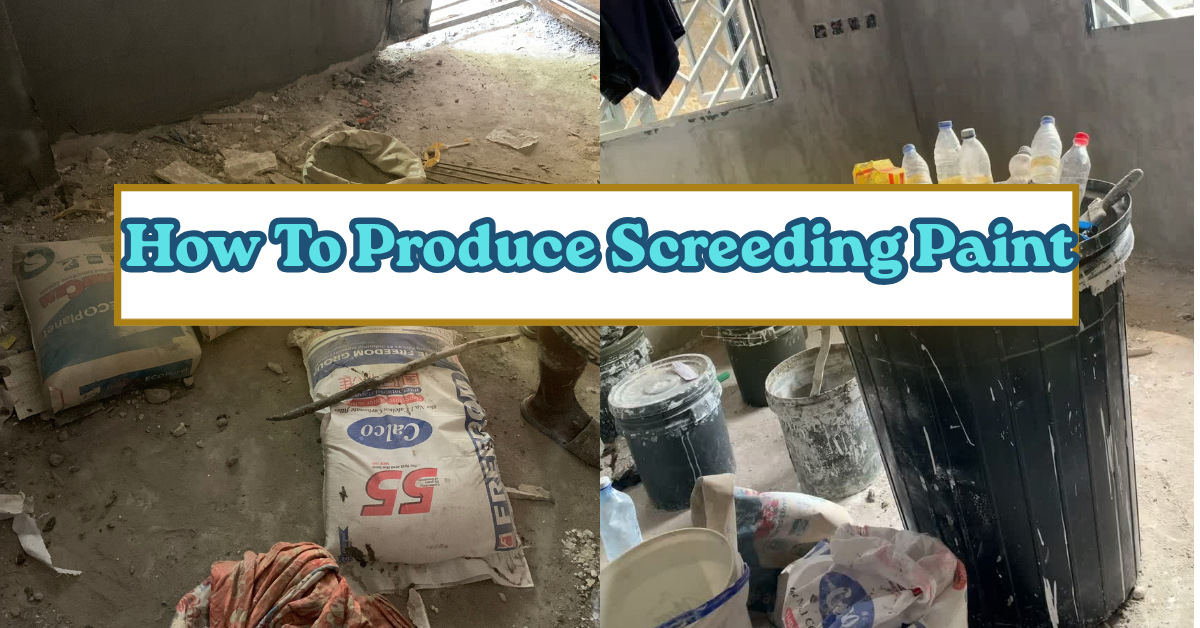
How to Produce Screeding Paint
Screeding Paint production is one of the most profitable manufacturing businesses that anyone can start with the right knowledge and guidance. Across Nigeria and many parts of Africa, the demand for quality paint continues to increase as new buildings, renovations, schools, offices, and commercial properties require paint every day.
Unfortunately, many aspiring entrepreneurs waste money on trial and error because they do not understand the correct paint production process or the functions of the chemicals used in manufacturing paint. This is why practical paint production training has become Important for anyone who wants to learn how to produce high quality paint that customers trust and pay for.
What Is Screeding Paint?
Screeding Paint production is the process of combining specific chemicals and raw materials in the correct proportions to create paint products used for surfaces preparation, this can be used for interior or exterior preparation.
The quality of the final paint depends on the quality of the raw materials used and the production process followed. When properly produced, Screeding paint can offer excellent coverage, durability, smooth application, and long shelf life.
Learning paint production gives you the opportunity to start your own manufacturing business, supply contractors, sell to paint retailers, and generate consistent income. Learn Paint Production Here
Why Learn Paint Production?
Learning paint production offers several benefits.
You can start a business with relatively low capital compared to many manufacturing industries.
You can produce paint from home before expanding into a larger facility.
The demand for paint remains constant because buildings require painting during construction and maintenance.
You gain a practical skill that can generate income for years.
You can supply paint directly to customers, contractors, builders, and hardware stores.
So Now, lets continue to producing our screeding paint.
Types of Paint Chemicals used in producing screeding Paint and Their Functions
Understanding paint chemicals is one of the most important aspects of paint production. Each chemical performs a specific function that contributes to the quality of the finished product. Also Read How To Produce Quality Emulsion Paint For Beginners
Calcium
Calcium is one of the primary materials used in paint production. It contributes significantly to the body and structure of the paint.
When mixed properly with water, calcium forms the foundation upon which other chemicals are added during production.
Genospor
Genopore serves as a preservative agent in paint production.
Its function helps improve the smooth application of paint on walls and contributes to maintaining product quality over time.
Formalin
Formalin is another important preservative used during paint production.
It helps protect the paint from spoilage and it also give the paint durability that make it stay longer on the bucket without getting spolied.
Ammonia
Ammonia is a very important preservative agent in paint production and it is a neccesity.
this is what bind and integrate every other chemicals together.
It contributes to the stability and durability of the paint while supporting proper chemical interaction within the mixture.
Thickener
Thickener is one of the most important chemicals in paint production.
without thickener, there’s no paint. this is what transform the paint from it watery Form to a more thicker form
Without the correct use of thickener, paint may become too watery and fail to provide proper coverage when applied to surfaces.
Application of Paint chemicals to produce screeding paint
Producing screeding paint involves a sequence of carefully followed steps.
Step 1: Prepare Clean Water
The production process begins with clean water placed inside a mixing container.
Water serves as the medium that allows other chemicals to dissolve and combine properly.
Step 2: Add Calcium
The next step is to add calcium into the water.
It is important to stir thoroughly until all particles dissolve completely. Proper mixing prevents lumps and ensures a smooth paint texture.
Step 3: Add Genopore
After the calcium has dissolved properly, genopor is added.
This makes the paint to run smoothly when applying on the wall, it also helps improve the quality of the paint.
Step 4: Add Formalin
Formalin is added as part of the preservation process.
Proper stirring ensures even distribution throughout the mixture.
Step 5: Prepare and Apply Thickener
Unlike some other chemicals, thickener should first be dissolved separately in water.
After proper dissolution, it is gradually introduced into the paint mixture while continuous stirring takes place.
This process allows the paint to develop its desired thickness and consistency.
Step 6: Add Ammonia
Ammonia is introduced into the mixture and stirred thoroughly.
This stage helps improve integration among the various paint chemicals.
Step 7: Continue Mixing
The paint should be mixed thoroughly until a uniform consistency is achieved.
At this stage, the paint begins to take shape and becomes ready for further finishing and packaging.
Common Mistakes Beginners Make in Paint Production
Many beginners encounter challenges because they skip important procedures.
Some fail to dissolve calcium properly before adding other chemicals.
Others apply thickener incorrectly without first dissolving it in a separate container.
Using poor quality chemicals can also reduce paint quality and customer satisfaction.
Following the correct process and using quality materials can help avoid these mistakes and produce paint that meets market standards.
How Paint Production Can Become a Source of Income
Paint production is more than just a technical skill. It is a business opportunity.
Once you understand the production process, you can begin manufacturing paint for residential projects, commercial buildings, schools, offices, churches, and construction companies.
Many successful paint manufacturers started on a small scale before expanding into larger operations.
As your reputation for quality grows, customer referrals and repeat purchases can help increase your income significantly. See our Courses
The Importance of Professional Paint Production Training
While free lessons can provide a basic understanding of paint production, professional training offers deeper knowledge and practical guidance.
Advanced paint production training often covers:
Raw material sourcing
Chemical measurement and quantities
Quality control procedures
Production techniques
Paint formulation
Business setup strategies
Marketing and customer acquisition
Mentorship and ongoing support
Having access to experienced instructors can help you avoid costly mistakes and accelerate your success in the paint manufacturing industry.
Conclusion
Paint production remains one of the most rewarding skills for aspiring entrepreneurs who want to build a profitable manufacturing business. By understanding the functions of paint chemicals, following the correct production process, and applying professional techniques, anyone can learn how to produce quality paint that customers trust.
Whether you are looking for a new source of income, a practical skill, or a full scale manufacturing business opportunity, learning paint production can open doors to long term financial growth. With the right training, commitment, and consistency, you can start producing quality paint and build a successful business from it. Watch screeding paint video tutorial here
FAQs
Can a beginner learn paint production?
Yes. With proper training and practical guidance, beginners can learn paint production successfully and start producing quality paint.
What chemicals are used in paint production?
Common paint chemicals include calcium, genopore, formalin, ammonia, and thickener. Each performs specific functions during production.
Is paint production profitable?
Yes. Paint production can be highly profitable because demand for paint remains strong in residential and commercial construction projects.
How long does it take to learn paint production?
Basic paint production can be learned within a short period. However, mastering advanced production techniques and formulations requires additional practice and training.
Do I need expensive equipment to start?
Not necessarily. Many small scale paint manufacturers start with basic equipment before expanding into larger production systems.
Where can I get professional paint production training?
Professional paint production training programs provide step by step guidance, practical demonstrations, mentorship, and business support for aspiring paint manufacturers.

Godwin Zion is the founder of Paint Production Academy and a professional paint production trainer with over 18 years of practical experience in paint production, POP ceiling installation, construction finishing, and interior project execution. He teaches practical emulsion, acrylic Matte, and satin paint production using simplified step-by-step methods designed for homeowners, painters, engineers, property developers, artisans, and entrepreneurs. Through Paint Production Academy, he has helped students across Nigeria, Ghana, Cameroon and other part of the world learn valuable paint production skills that can reduce construction costs and create profitable opportunities.