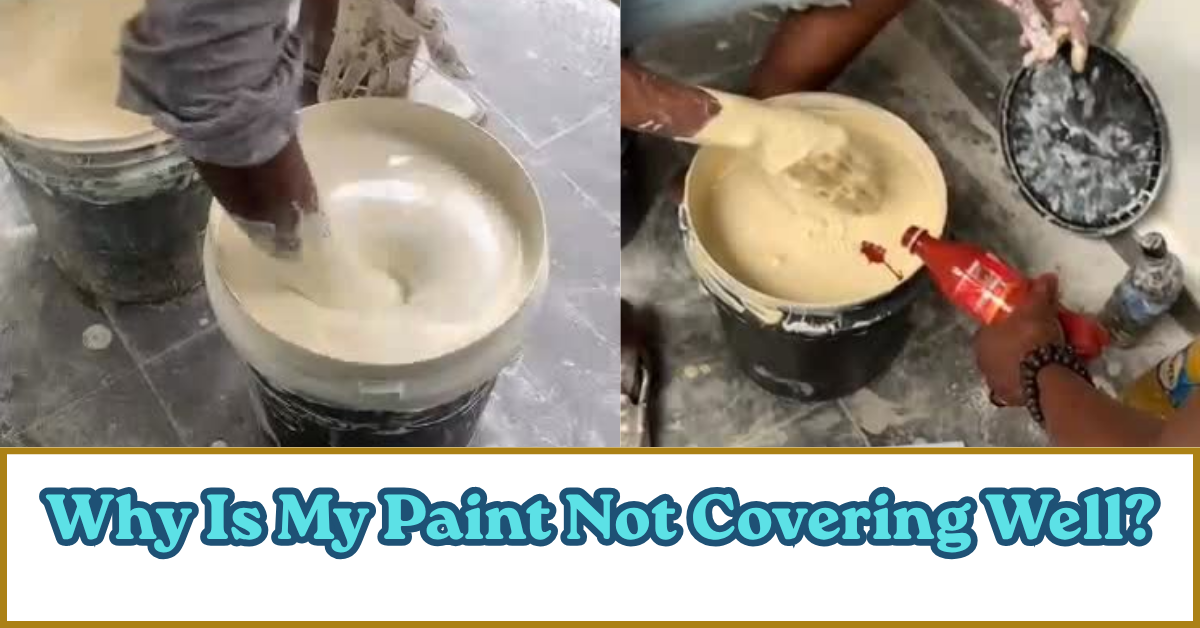
Why Is My Paint Not Covering Well? people ask all the time, Now, Have you ever applied paint to a wall only to discover that the screeded surface is still showing through? You apply another coat, wait for it to dry, and the wall still does not have the desired coverage you expected.
This is a common paint problem, but it does not always mean that the painter is doing something wrong. Poor paint coverage can come from the paint formulation, the quantity of materials used during production, the type of surface being painted, or the application method. Also read : Why Is My Paint Peeling? 10 Causes, Fixes and Prevention
For paint producers, painters, homeowners and property developers, understanding why paint does not cover properly can help prevent wasted materials, unnecessary coats and poor finishing.
In this article, we will look at nine major reasons why paint may not cover well and what you can do to improve the result.
What Does Poor Paint Coverage Mean?
Poor paint coverage, sometimes called poor hiding, occurs when the paint film does not sufficiently hide the surface underneath it.
For example, if you apply white paint to a wall and the original colour remains clearly visible after recommended coat has dried, the paint has poor hiding or coverage. See Paint Production Process for Beginners
Paint coverage depends on several factors, like the formulation process, pigment, surface condition, film thickness, colour underneath and application technique used.
1. Insufficient Titanium Dioxide During Paint Formulation
One of the important reasons a white or light-coloured paint may fail to cover or spread properly is insufficient titanium dioxide, commonly known as Titan.
Titanium dioxide is an important white pigment used in paint because of its ability to spread and also contribute significantly to hiding power of the paint.
If the quantity used during production is not sufficient for the type and quality of paint being produced, the finished paint may have reduced or poor coverage. see : Paint Chemicals and Their Functions: Complete List for Paint Production
This is important when producing white paint because the hiding ability of the product depends partly on the titan quantity used in the production.
How to fix it
The formulation should use industry recommended standard of correct raw materials and quantities for the intended paint quality, colour and application. See : How to Calculate Paint Production Materials for Emulsion, Matt, and Satin Paint
The pigment must be properly dissolved during production. Poor dissolving can affect the performance of titanium dioxide and reduce its contribution to hiding.
For paint producers, proper formulation and accurate measurement are therefore important.
2. The Type of Wall Surface Can Affect Paint Coverage
The surface receiving the paint also plays a major role.
A paint applied to a cement screeded wall may behave differently from the same paint applied to a properly prepared putty-screeded or POP-screeded surface.
Cement screeded surfaces can absorb more of the coating, particularly during the first coat. This can make the paint appear as though it is not covering properly. porous surfaces and rough plaster can also cause poor coverage.
From practical painting experience, a cement screeded wall may require around three to four coats to achieve the desired appearance, depending on the condition of the wall, the paint and the colour being applied.
On a putty-screeded wall, two coats may be enough to achieve the desired coverage. The same can apply to a POP-screeded surface.
The exact number of coats should not be treated as a universal rule because coverage depends on the paint, colour and application method.
How to fix it
Prepare the wall properly before applying the finishing paint. see: How to Prepare Walls Before Painting: Tips for a Perfect Finishing
A properly prepared surface can reduce excessive absorption and help the finishing paint form a more uniform film.
3. Insufficient Thickener Can Affect Paint Performance
Another formulation issue is insufficient thickener used to control the paint film and application properties.
If the formulation does not have recommended quantity of thickener, the paint may not behave properly during application. The coating can become too thin, or difficult to apply.
How to fix it
Follow the approved formulation for the specific paint being manufactured and measure every material accurately.
Do not increase or reduce a thickener simply because the paint appears too thick or too thin. This is one reason why accurate paint production measurements are important.
4. Too Much Water During Formulation
Another common reason paint fails to cover properly is excessive water.
During paint production, every material has a role and the quantity used must be controlled. If more water is added than the formulation requires, the quality of the paint and pigments used can be reduced.
How to fix it
Use the correct quantity of water specified by the formulation. Do not add extra water simply to increase the volume of the finished paint.
5. Poor Balance of Formulation Additives Can Affect Finishing and Film Formation
Paint formulation is not just about adding pigment and water. Different ingredients work together to determine the appearance, quality, application properties and performance of the paint.
How to fix it
Use the correct formulation and avoid adding additives randomly.
The objective is not to use more chemicals. The objective is to use the correct materials in the correct proportions so that the paint performs as intended.
6. The Paint Is Being Applied Too Thinly
Even a properly formulated paint can appear not to cover if the applied film is too thin.
When a painter tries to spread a limited quantity of paint over a very large surface, the resulting film may be too thin to hide the surface underneath.
This is one of the recognised causes of poor hiding. See: Chemicals for Matt Paint: Complete List and Their Functions
How to fix it
Apply the recommended quantity of paint to the surface instead of trying to make a small quantity cover an unnecessarily large area.
Allow each coat to dry properly before deciding whether another coat is required.
Do not judge coverage only while the paint is wet. The appearance can change as the coating dries.
7. Poor Mixing
Paint materials can settle or become unevenly distributed during storage and production.
If the paint is not properly mixed before application, the composition of the material being applied may not be uniform.
Poor mixing can therefore contribute to inconsistent coverage.
How to fix it
Mix the paint thoroughly before application according to the requirements of the particular product.
For paint manufacturers, proper dissolving during production is even more important because pigment and other raw materials must be distributed appropriately throughout the coating.
8. The Colour Underneath Is Too Dark
Sometimes the problem is not necessarily that the paint is defective. The colour underneath can make coverage appear poor.
For example, applying a light colour over a much darker wall can require more coats than applying the same colour over a similar or lighter surface.
The contrast between the existing surface and the new paint can make imperfections and colour show-through much more obvious. Painting guidance identifies a strong difference between the old and new colours as a common cause of poor hiding.
Some colours also naturally have lower coverage than others. Certain bright or strongly tinted colours can require additional coats depending on the pigment system and application conditions.
How to fix it
Where necessary, use an appropriate primer or undercoat before applying the final colour.
If you are changing from a very dark wall to a much lighter colour, preparing the underlying surface can significantly improve the efficiency of the finishing coats.
9. Poor Application Technique
The final major cause is the way the paint is applied.
A correctly formulated paint can still produce poor coverage if the painter uses an unsuitable roller, brush or spray technique.
The amount of paint deposited on the surface matters. The wrong roller nap, poor application technique or excessive working of the paint can result in a coating that is too thin or uneven.
How to fix it
Use the appropriate application tool for the paint and surface.
Avoid repeatedly spreading the same small quantity of paint across a large area simply to make it go farther.
Apply the paint evenly and maintain a consistent film thickness. Where multiple coats are required, allow the previous coat to dry properly before applying the next one.
How to Fix Paint That Is Not Covering Well
If your paint is already on the wall and you notice poor coverage, do not immediately assume that the entire paint batch is bad.
First, determine what is causing the problem.
Check the paint formulation if you produced the paint yourself. Confirm that the titanium dioxide, thickener, water and other ingredients were measured correctly.
Next, examine the surface. Determine whether the wall is cement-screeded, putty-screeded, POP-screeded or another type of substrate. Check whether the surface is excessively porous, dusty, rough or inadequately prepared.
Then check the application. Was too much water added? Was the paint spread too thinly? Was the correct roller or brush used? Was the paint mixed properly?
Finally, consider the colour underneath. A very light paint applied over a dark colour may naturally require additional preparation or coats.
These steps help you identify the actual cause instead of simply adding more coats and hoping the problem disappears.
Conclusion
When paint does not cover well, the problem can start long before the painter opens the paint bucket.
It can begin during formulation through insufficient titanium dioxide, incorrect quantities of thickener or other formulation materials, or excessive water. It can also result from the type and condition of the wall, the colour underneath, poor mixing, insufficient film thickness or incorrect application.
This is why paint production requires accurate measurement and proper understanding of what each raw material contributes to the finished product. See How to Calculate Paint Production Materials for Emulsion, Matt, and Satin Paint
For painters and homeowners, proper surface preparation and application are equally important.
Good paint coverage is therefore not simply about putting more paint on the wall. It is about using a properly formulated coating, applying it correctly and preparing the surface appropriately.
FAQs
1. Why is my paint not covering well?
Paint may not cover well because of insufficient titanium dioxide, excessive water or thinning, poor formulation, inadequate surface preparation, a porous wall, insufficient film thickness, poor mixing, strong colour contrast or incorrect application technique.
2. Why does my paint require so many coats?
The number of coats required depends on the paint, surface, colour underneath and application method. Porous cement surfaces and major colour changes may require more coats than properly prepared putty-screeded surfaces.
3. Does adding more water make paint cover better?
No. Adding excessive water can reduce the concentration of the paint’s solids and pigments and may reduce hiding power. Always follow the correct formulation or manufacturer’s thinning instructions.
4. Does titanium dioxide improve paint coverage?
Titanium dioxide contributes significantly to the hiding power of many white and light-coloured coatings because of its strong light-scattering properties. The correct quantity and dispersion depend on the formulation.
5. Why does white paint not cover a dark wall?
White or other light colours can require additional coats when applied over a much darker colour because the contrast makes the underlying colour easier to see. An appropriate primer or undercoat can help reduce this problem.
6. Can poor wall preparation cause poor paint coverage?
Yes. Porous, rough or highly absorbent surfaces can cause the coating to be absorbed unevenly and can make the paint appear to have poor coverage. Proper preparation and, where appropriate, priming can improve the result. See More…

Godwin Zion is the founder of Paint Production Academy and a professional paint production trainer with over 18 years of practical experience in paint production, POP ceiling installation, construction finishing, and interior project execution. He teaches practical emulsion, acrylic Matte, and satin paint production using simplified step-by-step methods designed for homeowners, painters, engineers, property developers, artisans, and entrepreneurs. Through Paint Production Academy, he has helped students across Nigeria, Ghana, Cameroon and other part of the world learn valuable paint production skills that can reduce construction costs and create profitable opportunities.