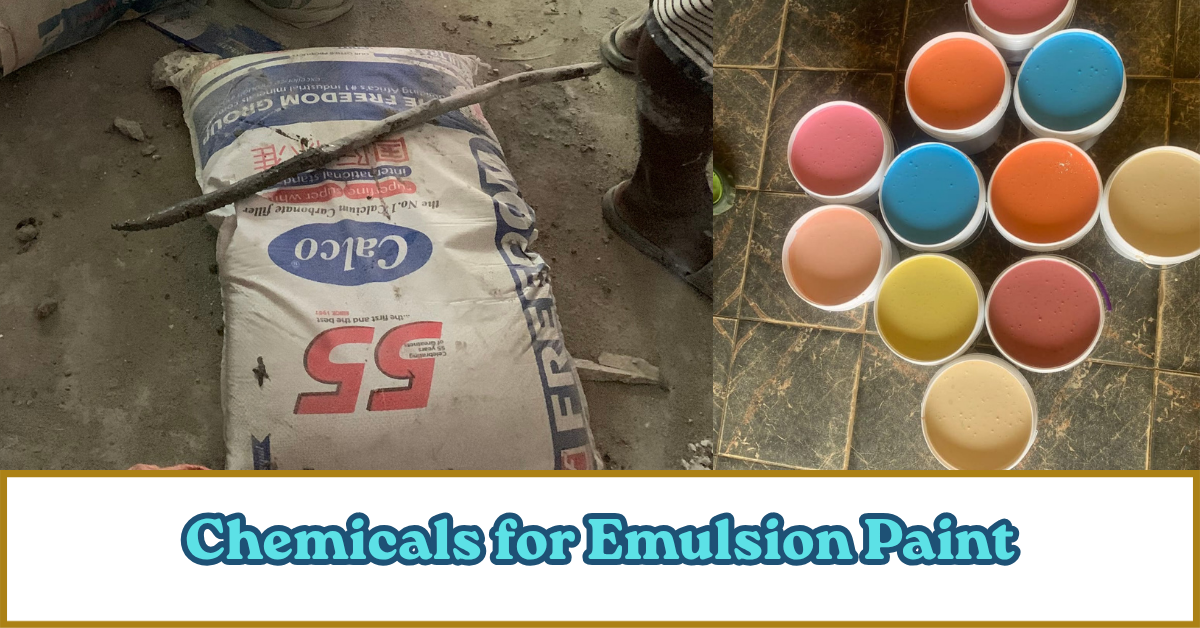
Chemicals for Emulsion Paint
Emulsion paint is one of the most widely used paints for interior and exterior walls and ceilings, but producing quality emulsion paint requires more than simply mixing chemicals together.
Each raw material and chemicals has a specific function. Some provide colour and coverage, some form the paint film, some control thickness, while others give stability, prevent microbial growth, control foam or help the ingredients remain durable and solid for months.
If you are searching for chemicals for emulsion paint, you may be looking for a list of raw materials to start production. But knowing the names of the materials is only the first step. Understanding what each one does is what helps you produce good and consistence paint.
This article explains the common emulsion paint raw materials, their functions, common formulation mistakes and the factors that affect the quality of emulsion paint.
What Is Emulsion Paint?
Emulsion paint is generally a common type of paint in which acrylic gum or PVA, pigments and other ingredients are mixed in water.
It is widely used for interior or exterior walls and ceilings depending on the formulation.
The final properties of emulsion paint depend on the type and quality of the raw materials, their quantity, the manufacturing process used in production.
A good formulation should have appropriate coverage, adhesion, stability and durability to withstand terrible weather conditions.
What Chemicals Are Used to Make Emulsion Paint?
The exact formulation varies between manufacturers and product grades.
However, common raw-material categories can include water, Calcium, pigments, dispersants, thickeners, defoamers, preservatives, and other additives.
Not every emulsion paint uses exactly the same materials or quantities.
A premium emulsion, economy emulsion and exterior emulsion can have substantially different formulation requirements.
1. Water
Water is commonly the main carrier in emulsion paint.
It allows the different ingredients to be dissolved and mixed into a workable coating.
After the paint is applied, water gradually evaporates as the coating dries.
Water also affects coverage, application and solids concentration.
Adding excessive water may make paint easier to spread, but it can also reduce the durability and how solids the paint will be after drying.
For this reason, water should be measured as part of the formulation rather than added randomly until the paint “looks right.”
2. Titanium Dioxide
Titanium dioxide is commonly used as a white pigment in paint formulations.
It contributes to whiteness, brightness and coverage because of its strong light-scattering ability.
In white and light-coloured emulsion paint, titanium dioxide can have a big impact and influence on the appearance and finished coating.
However, paint coverage does not depend on titanium dioxide alone.
Pigment dispersion, binder level, calcium type, or thickener you use and surface preparation can all impact the final result.
3. Calcium Carbonate
Calcium carbonate is commonly used as a filler in paint formulations.
Depending on the type of paint but calcium is the paint itself, it is the solid content, body and texture of paint.
However, calcium carbonate should not be viewed simply as a material that can be added in large quantities.
The amount and quantity used need to be appropriate based on recommended industry standard to get a quality product.
Excessive filler and less binder system can affect adhesion, durability and resistance to washing and chalking.
4. Thickener
Thickeners help to transform the paint from the watery form to thick form.
The right quantity allows the paint to be mixed and applied properly.
If the paint is too thin, it may run easily and be dripping from roller and also provide poor coverage.
If it is too thick, it may become difficult to stir, brush or roll.
The type and quantity of thickener required depend on how many number of rubbers you want to produce.
5. Defoamer
Foam can develop during the manufacturing process, particularly during vigorous mixing.
A defoamer helps control unwanted foam.
Excessive foam can create problems during production and application and can make it difficult to obtain a consistent finishing.
However, defoamer must be used appropriately because excessive amounts may negatively affect other chemicals.
6. Preservatives
Emulsion paint can be vulnerable to microbial contamination because water and certain organic ingredients can support microbial growth.
Preservatives may be used to protect the product against microbial spoilage during storage and use.
The appropriate preservative depends on the formulation, how long you want paint to remain in storage condition.
Preservatives should always be handled according and carefully.
Before reading further, Kindly answer 👇this question
Do you Want to Produce These Paints Yourself?
If you have ever wanted to manufacture quality emulsion, acrylic matte, and satin paints instead of buying them, this is exactly what we teach inside Paint Production Academy.
The training covers:
Professional paint formulas
Material selection
Mixing procedures
Quality control
Cost calculation
Production for small and commercial quantities
How to start a profitable paint business
Many of our students now produce paint for personal projects and commercial sales.
Learn more about the complete Paint Production Training here.
Let’s continue to next chemical..
7. Biocides
Also a preservative agent but adding Certain biocidal additives may be used to control microorganisms in the formulation and also provide protection when the coating is dry.
The correct material and dosage depend on the intended purpose.
Manufacturers should not randomly apply biocides. They should follow industry recommended standard.
8. Polymer Binder
The polymer binder is one of the most important components of emulsion paint production.
This act as gum to help bind the paint film after the water evaporates and contributes to make paint solid, and durable.
The type and quality of binder (gum) can make a major difference in the finished product.
A formulation with small binder (gum) relative to its other chemical may produce a product that chalk, wash, and start peeling so soon.
This is why reducing binder simply to make production cheaper can affect the quality of the finished paint. See: How To Produce Quality Emulsion Paint For Beginners
9. Dispersing Agent
A dispersing agent helps dissolve pigments and other solid particles throughout the liquid phase.
Proper dispersion is important because pigments and fillers need to be thoroughly dissolve.
Poor dissolving of pigment can result in discolouring, settling, poor coverage and inconsistent texture.
This is why mixing technique and sequence are important parts of emulsion paint production.
10. Colour Pigments and Colourants
White emulsion paint primarily relies on white pigments for its appearance, while coloured emulsion paint requires suitable colour pigments or colourants.
Different pigments have different levels of colour strength, stability and resistance.
This is why colour matching requires careful measurement.
Adding colourant randomly can make it difficult to reproduce the same shade in another batch.
How to Calculate Emulsion Paint Production Materials
Once you have a tested formulation, you need to be able to calculate the quantity required for different production volumes.
A formulation designed for a small batch must be scaled correctly when producing multiple drums.
For example, if a formulation is designed for one production batch, multiplying the quantities incorrectly can affect the balance of the entire formulation.
Accurate quantification helps reduce material waste and makes production more consistent.
This is also where a Paint Materials Quantification Workbook pdf can become useful.
Instead of calculating every material from scratch each time, you can download the paint quantification work book here this will help you organize the quantities required for different production volumes and use the information when planning future batches.
Mistakes Beginners Make When Buying Emulsion Paint Chemicals
One common mistake is buying raw materials solely because they are cheap.
Another is purchasing materials without checking their grade or quality.
A third mistake is buying from unreliable suppliers and then blaming the formulation when the raw-material quality is inconsistent.
Beginners also sometimes purchase chemicals without proper storage arrangements.
Raw materials should be stored according to supplier recommendations and protected from contamination, heat, moisture or other unsuitable conditions.
Safety When Handling Emulsion Paint Chemicals
Paint production involves chemical materials, so appropriate safety precautions are important.
Wear suitable protective equipment when handling raw materials.
Avoid unnecessary contact with skin, eyes and inhaling.
Provide adequate ventilation in the production area.
Keep chemicals properly labelled.
Do not store incompatible materials together.
Keep chemicals away from children and unauthorized persons.
Read the supplier’s Safety Data Sheet before using unfamiliar materials.
Different raw materials have different hazards, so always follow the specific safety instructions provided for the product.
FAQs
1. What chemicals are used to make emulsion paint?
Chemical for Emulsion paint include water, polymer binder, pigments, fillers or extenders, dispersants, thickeners, defoamers, preservatives and other additives. The exact formulation depends on the desired product quality and performance.
2. What are the raw materials for emulsion paint?
The raw materials can include water, polymer binder, titanium dioxide or other pigments, calcium carbonate and other fillers, thickeners, dispersants, preservatives.
3. What chemicals are needed to make emulsion paint in Nigeria?
The materials depend on the type and quality of emulsion paint being produced. A typical common emulsion formulation can contain a binder, pigments, fillers, water and functional additives.
4. What is the function of calcium carbonate in emulsion paint?
Calcium carbonate commonly functions as a filler. It is the solids, and body of paint.
5. What is the function of titanium dioxide in emulsion paint?
Titanium dioxide is commonly used as a white pigment. It contributes to whiteness, brightness and coverage.
6. What is the function of PVA in emulsion paint?
PVA is a term commonly used in the Nigerian paint industry for certain polymer-based binder products or gum. Depending on the specific material, it contribute to make the paint not to chalk, peel or wash.
7. Why does emulsion paint become watery?
Excessive water, poor formulation, not enough thickener or calcium.
8. How can I make emulsion paint thicker?
The correct approach depends on why the paint is too thin. Simply adding a some quantity of thickener can help but the formulation should be assessed and adjusted systematically.
Final Thoughts
Understanding the chemicals for emulsion paint is important if you want to produce consistent and reliable paint.
However, knowing the chemical names is not enough.
You need to understand the role of each material, how the materials interact and how changes in formulation can affect the finished product.
Water provides the carrier system.
The polymer binder contributes to film formation and adhesion.
Pigments provide colour and coverage.
Fillers contribute solids and body.
Dispersants support proper particle dissolving.
Thickeners control coverage.
Defoamers control unwanted foam.
Preservatives help protect susceptible water-based products.
Other additives can provide specific properties depending on the formulation.
The most important principle is balance.
A good formulation is not necessarily the one containing the highest amount of expensive materials. It is the formulation that achieves the required performance consistently at a commercially sensible cost.

Godwin Zion is the founder of Paint Production Academy and a professional paint production trainer with over 18 years of practical experience in paint production, POP ceiling installation, construction finishing, and interior project execution. He teaches practical emulsion, acrylic Matte, and satin paint production using simplified step-by-step methods designed for homeowners, painters, engineers, property developers, artisans, and entrepreneurs. Through Paint Production Academy, he has helped students across Nigeria, Ghana, Cameroon and other part of the world learn valuable paint production skills that can reduce construction costs and create profitable opportunities.