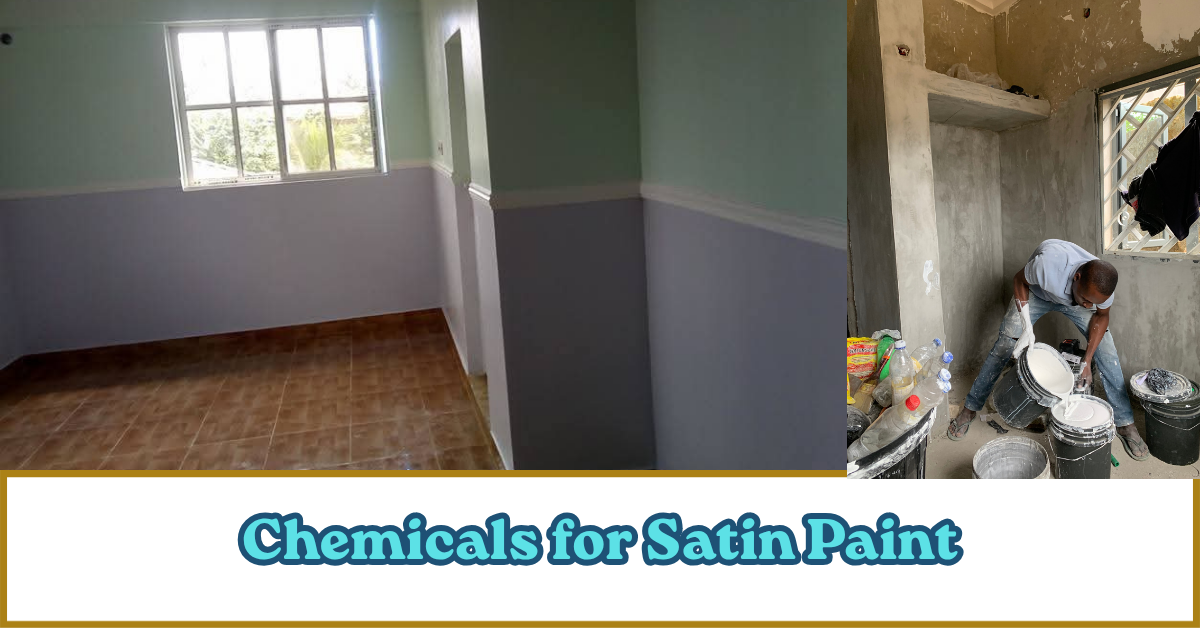
Chemicals for Satin Paint
Satin paint is known for its smooth appearance, soft sheen and glittering appearance, making it a very popular choice for interior walls.
But what chemicals are used to make satin paint?
If you are learning paint production, understanding the answer is important because satin paint is not simply matt paint with extra colour or calcium added. The formulation needs to be properly balanced to achieve the desired sheen, smoothness, coverage, adhesion and durability.
Many people searching for chemicals for satin paint want to know the raw materials required for production and the function of each one. A list of chemicals is useful, but understanding their individual roles is far more important.
In this article, i share and explain the major satin paint raw materials, what they do, how they influence the finished product, common formulation mistakes and important factors to consider when producing satin paint.
What Is Satin Paint?
Satin paint is a coating designed to produce a soft or moderate sheen after drying.
It naturally has more sheen than matt paint.
The level of sheen depends on the formulation, the binder system, pigment, surface preparation, and application method.
Satin finishing is recommended in selected areas or space where a smoother appearance and easier cleaning are desired.
However, the exact properties and quality of a satin paint depend on how it is formulated.
What Chemicals Are Used to Make Satin Paint?
The exact raw materials depend on the type of quality level and manufacturing process of your satin paint.
satin paint can contain water, polymer binder, pigments, dispersants, thickeners, defoamers, preservatives, pH adjusters and other additives.
Not every satin paint contains exactly the same ingredients.
A premium satin paint designed for durability may have a substantially different formulation from a low-cost finishing product.
The important principle is to understand the function of each raw material and how the ingredients work together.
1. Water
Water is commonly used as the primary carrier in satin paint.
It allows the binder, pigments, and additives to be distributed into a workable coating.
After application, the water evaporates as the paint dries.
However, excessive water can reduce how solids the content of paint should be and may negatively affect coverage, film formation and durability.
For this reason, water should be measured carefully rather than adding randomly.
2. Titanium Dioxide
Titanium dioxide is commonly used as a white pigment in paint formulations.
It contributes to whiteness, brightness and coverage because it scatters light effectively.
titanium dioxide have a significant effect on the final appearance of satin paint.
However, the final coverage and appearance do not depend on titanium dioxide alone.
Pigment dissolving, binder concentration, film thickness and surface preparation all contribute to the result.
3. Polymer Binder
The polymer binder can also be referred to as gum plays a very big role in satin paint.
It helps bond and form the film after the water evaporates and contributes to adhesion, durability, and resistance to stains.
The binder or gum also has an important relationship with the final appearance of the coating.
If the gum level is too low for the production, the finished coating may have poor film properties, less solid and reduced durability.
Always follow the recommended industry standard of appropriate binder to achieve a quality and durable satin people will love and recommend.
4. Dispersing Agent
Dispersants help dissolve pigments and other solid particles throughout the liquid phase.
Dispersing agent is also a very important chemical in satin paint production, Proper dissolving is vital for achieving consistent colour, appearance and stability.
Poor dispersion can produce discolouring, little particles, poor coverage and inconsistent texture.
This is why mixing sequence and dispersion are important parts of satin paint manufacturing.
5. Thickener
Thickeners control thickness and flow behaviour.
The right thickness allows the satin paint to be mixed, brushed or rolled easily and effectively.
If the paint is too thin, it may run, spill and drip or provide poor application process.
If it is too thick, application can become difficult.
The appropriate thickener system depends on the formulation, the quantity you want to produce and the interaction between the binder (gum), water and other ingredients.
6. Preservatives
Satin paint can be susceptible to microbial contamination.
Preservatives can help protect the product from microbial spoilage during storage and use.
The appropriate preservative quantity depends on the formulation and storage conditions.
Because preservatives are active chemical materials, they should always be handled and treated with care and also follow recommended industry standard because of it hazardous nature.
Before reading further, Kindly answer 👇this question
Do you Want to Produce These Paints Yourself?
If you have ever wanted to manufacture quality emulsion, acrylic matte, and satin paints instead of buying them, this is exactly what we teach inside Paint Production Academy.
The training covers:
Professional paint formulas
Material selection
Mixing procedures
Quality control
Cost calculation
Production for small and commercial quantities
How to start a profitable paint business
Many of our students now produce paint for personal projects and commercial sales.
Learn more about the complete Paint Production Training here.
Let’s continue with our article, Next chemical,
7. Colour Pigments
Satin paint can be produced in different colours.
Colour pigments or suitable colourants provide the desired shade.
Different pigments have different colour strength, stability and resistance to stains.
Accurate colour measurement is important because small changes can significantly alter the final shade.
Why Satin Paint Formulation Is Different From Matt Paint
Matt and satin paints can share several raw-material categories, but the formulation does not necessarily have the same balance and outcome.
Matt paint is designed for a lower-sheen appearance.
Satin paint is designed to produce a more noticeable soft sheen.
The difference in appearance is influenced by the formulation method and process.
This is why you should not assume that simply adding some satin ingredient to matt paint will automatically produce a good satin coating.
Why the Binder Is Important in Satin Paint
The binder has a particularly important role in the final coating film.
It helps hold the solid particles together and contributes to adhesion and durability.
The binder system can also influence how the dried coating reflects light.
A formulation that is not properly balanced may produce a finish that does not have the desired appearance or durability.
This is why reducing binder simply to save money can be a poor long-term strategy.
Satin Paint Production Mistakes
Using an inappropriate formulation
A formula designed for matt paint should not automatically be used for satin paint.
The target finishing requires an appropriate formulation strategy. See: How To Produce High Quality Satin Paint Complete Training
Adding too much water
Excessive dilution can reduce coverage and spreading performance.
Poor dispersion
Poor mixing and dissolving of pigment can lead to discolour and poor finshing.
Guessing quantities
Inaccurate measurements make it difficult to reproduce successful batches.
How to calculate and Scale Satin Paint Production from 1 drum to 5 drums and above
If you produce a small batch and want to increase production, you need a reliable method for scaling your materials.
For example, the quantity required for one production batch will need to be adjusted when producing several drums.
Incorrect scaling can produce significant formulation errors.
This is why we created a pdf of Paint Materials Quantification Workbook that can make this process easier by helping you organize the quantities required for different production volumes.
Accurate quantification can reduce waste and improve batch consistency. download your workbook here
FAQs
1. What chemicals are used to make satin paint?
Satin paint is formulated with water, polymer binder, pigments, dispersants, thickeners, defoamers, preservatives, pH adjusters and other additives depending on the formulation.
2. What are the raw materials for satin paint?
Common raw-material categories include water, polymer binder, pigments, thickeners, dispersants, preservatives, defoamers and other performance additives.
3. What chemicals are used for satin paint production?
The exact chemicals depend on the formulation and intended product. A water-based satin coating may contain a combination of binder, pigments, and other functional additives.
4. What is the function of titanium dioxide in satin paint?
Titanium dioxide is a very important chemical used as a white pigment and it contributes to whiteness, brightness and coverage.
5. What is the function of thickener in satin paint?
A thickener helps control thickness and flow, which affects how the paint is mixed and applied.
6. Can I use matt paint chemicals to make satin paint?
No. but Some raw-material categories used in matt paint production can also be used in satin production.
7. Why is my satin paint too thick?
Possible causes include excessive thickener.
8. Why is my satin paint too thin?
Excessive water, insufficient thickener control or formulation imbalance can contribute to low thickness.
9. Why does satin paint not have enough sheen?
The final sheen can be affected by binder (gum) quantity, formulation imbalance, pigments, and poor surface preparation.
Final Thoughts
Understanding the chemicals for satin paint is important for anyone who wants to manufacture a consistent satin coating.
But the real skill goes beyond memorising a list of raw materials. Watch video tutorial here on how to produce satin paint.
You need to understand the function of each material and how it interacts with the other ingredients. See more..

Godwin Zion is the founder of Paint Production Academy and a professional paint production trainer with over 18 years of practical experience in paint production, POP ceiling installation, construction finishing, and interior project execution. He teaches practical emulsion, acrylic Matte, and satin paint production using simplified step-by-step methods designed for homeowners, painters, engineers, property developers, artisans, and entrepreneurs. Through Paint Production Academy, he has helped students across Nigeria, Ghana, Cameroon and other part of the world learn valuable paint production skills that can reduce construction costs and create profitable opportunities.