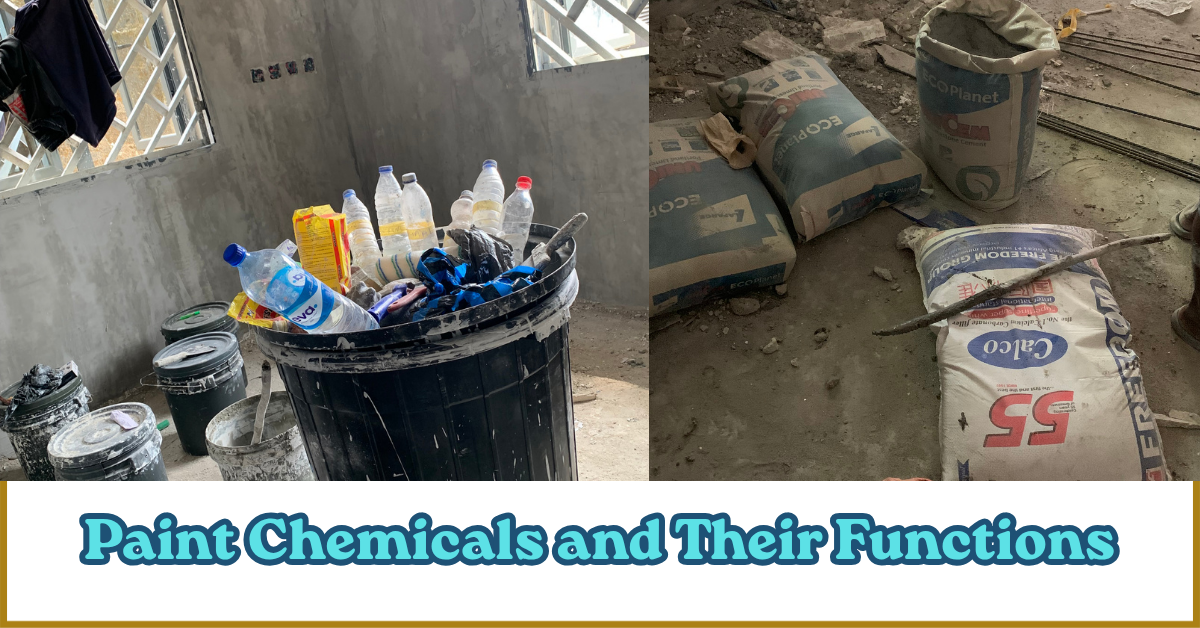
Paint Chemicals and Their Functions
If you want to produce quality paint, one of the first things you need to understand is the function of each raw material or chemicals used in the formulation. Paint is not simply a mixture of chemicals poured together. Each material has a specific role, and the quantity and quality of those materials can affect the paint’s colour, coverage, thickness, adhesion, durability, smoothness and overall performance.
Many beginners search for a paint chemicals list because they want to know what materials are required to produce emulsion, matt or satin paint. However, knowing the names of the chemicals is only the beginning. You also need to understand what each material does and what can happen when it is used incorrectly.
In this article i will share and explain the major paint chemicals and their functions, the different categories of paint raw materials, chemicals commonly used in different types of paint, common production mistakes, and important safety considerations.
What Are Paint Chemicals?
The term “paint chemicals” is commonly used to describe the raw materials and additives used to manufacture paint and other coatings.
These materials can include pigments, binders, fillers, solvents, thickeners, dispersing agents, preservatives, defoamers, and other additives.
The exact formulation depends on the type of paint being produced.
For example, the materials required for emulsion paint will not necessarily be identical to those required for satin paint or other specialised coatings.
A good paint formulation therefore depends on selecting suitable raw materials and using them in the correct proportions.
Main Categories of Paint Raw Materials
Paint raw materials can generally be grouped according to the function they perform in paint production.
The major categories include pigments, binders, extenders, carriers or solvents, thickeners, dispersants, defoamers, preservatives and other performance additives.
Understanding these categories makes it easier to understand why each ingredient is included in a formulation.
1. Pigments
Pigments provide colour and, depending on the pigment, it can also contribute to hiding power and coverage.
One of the most important white pigments used in many paint production is titanium dioxide.
Titanium Dioxide
Titanium dioxide is widely used as a white pigment because of its ability to act as a coverage or spreader.
In practical terms, it helps paint produce a brighter appearance, coverage and make paint spread when applying on the wall.
The quality and amount of titanium dioxide can influence the coverage and how your paint spread on the wall or ceiling.
Using too little can result in poor coverage, while simply adding more above industry recommended standard does not automatically guarantee a better paint. The overall formulation, mixing process, system and techniques with other raw materials also matter.
Colour Pigments
Colour pigments are responsible for producing different shades of paint.
Depending on your desired colour, manufacturers may use different pigments combination to get their desired colour.
The pigment selected can influence colour strength, durability, stability, weather resistance and cost.
This is why professional paint production requires more than simply adding a colourant until the desired shade appears.
2. Calcium Carbonate
Calcium carbonate is commonly refer to as filler or extender in many paint formulations.
This is what contribute to the body and solids content of the paint depending on the type of paint you are manufacturing.
However, calcium carbonate needs to be added base on recommended industry standard to give you the desired quality you need for your paint.
If your production contains excessive filler than the binders or additive in your paint, the finished paint can have less durability, poorer adhesion or weaker resistance to washing or chalking.
For this reason, understanding the relationship between the right quantity for your calcium and binders is important when producing quality paint.
3. Acrylic
The is one of the most important components of paint production.
It helps hold the pigment and other solid materials together after the paint dries and contributes to adhesion, durability, flexibility and resistance properties.
The binder or acrylic gum plays a very important role on how solid, or durable your paint perform and how long it can last when applied to the wall.
A production with not enough acrylic or reommended quantity for each type of paint will produce a paint that chalks, peel and cannot withstand weather changes for long.
4. PVA
PVA is a term commonly used in the Nigerian paint-making environment when referring to certain polymer-based binders.
However, it is important not to treat every product sold under the general description “PVA” as chemically identical.
The exact polymer, grade and intended application matter.
PVA is commoenly use in an emulsion paint it serves as gum that help form the film that remains on the surface after water evaporates.
If properly applied they can influence adhesion, flexibility, durability, resistance to washing and resistance to different weather condition.
For anyone learning paint production, it is therefore important to understand the specific product being purchased rather than relying only on a generic chemical name.
5. Water
Water is a neccesity in paint production.
It acts primarily as a carrier for the other ingredients and allows the formulation to be mixed, processed and applied.
After application, much of the water evaporates as the coating dries.
However, adding more water is not always the answer when paint appears too thick.
Excessive dilution can reduce solids content and may negatively affect coverage, and durability.
The correct amount depends on the formulation and the properties of the raw materials being used.
6. Thickeners
Thickeners help to tranform the paint from a watery form to a more thicker form, this what control the flow of the paint.
The right quantity and application method is important because paint that is too thin may run excessively or provide poor coverage, while paint that is too thick can be difficult to mix, pump, brush or roll.
Thickeners also influence the way paint behaves during application.
Using too much can make paint excessively thick or difficult to apply, while using too little can result in poor body and flow.
7. Dispersants
Dispersants help distribute solid particles such as pigments and calcium throughout the liquid phase of a paint formulation.
Good dispersion is important for achieving consistent colour, stability and performance.
Poor dispersion can result in problems such as settling, uneven colour, and poor coverage.
This is one reason proper mixing technique is just as important as selecting the right raw materials.
8. Defoamers
Foam can develop during mixing and manufacturing, particularly when mechanical agitation is involved.
Defoamers are used to control unwanted foam in the formulation.
Without adequate foam control, trapped air can create problems during manufacturing and application.
A properly formulated paint should have controlled foam characteristics without compromising other performance properties.
9. Preservatives and Biocides
Water-based paints can provide an environment where microorganisms may grow if the formulation is not adequately protected.
Preservatives and biocides can help protect the product against microbial contamination during storage and use.
However, these materials require careful handling and correct formulation.
Using excessive amounts does not automatically make a paint better. Chemical additives should be selected and used according to their intended purpose and supplier guidance.
Before reading further, Kindly answer 👇this question
Do you Want to Produce These Paints Yourself?
If you have ever wanted to manufacture quality emulsion, acrylic matte, and satin paints instead of buying them, this is exactly what we teach inside Paint Production Academy.
The training covers:
Professional paint formulas
Material selection
Mixing procedures
Quality control
Cost calculation
Production for small and commercial quantities
How to start a profitable paint business
Many of our students now produce paint for personal projects and commercial sales.
Learn more about the complete Paint Production Training here.
lets continue with our articles,
Paint Chemicals and Their Functions (summary)
Understanding the basic function of each category makes paint formulation easier to understand.
Pigments provide colour and can contribute to coverage.
Binders form the film and contribute to adhesion and durability.
Calcuim contribute to solids, and body of the paint.
Water or other carriers help distribute the ingredients and allow application.
Thickeners transform paint from watery form to thicker form.
Dispersants help distribute pigments and fillers.
Defoamers control unwanted foam.
Preservatives protect paint from microbial growth and giv paint durability..
Chemicals Used to Make Emulsion Paint
Emulsion paint is one of the most common paint used for interior and exterior applications.
It formulation may contain a combination of water, polymer binder, pigments, fillers, dispersants, thickeners, preservatives, defoamers and other additives. See: Chemicals for Emulsion Paint: Complete List and Their Functions
Chemicals Used for Matt Paint
Matt paint is generally designed to produce a low-sheen or flat appearance.
The formulation may contain pigments, polymer binder, fillers, water and various additives required to achieve the desired viscosity, stability, application properties and finishing. See: Chemicals for Matt Paint: Complete List and Their Functions
Chemicals Used for Satin Paint
Satin paint has a higher sheen than a traditional matt finish.
Its formulation therefore needs to provide an appropriate balance of binder, pigment, additives and other components to achieve the desired appearance and performance. see: Chemicals for Satin Paint: Complete List and Their Functions
Why Paint Chemical Quality Matters
Two manufacturers can use similar categories of raw materials but produce very different quality levels.
The difference can come from the grade and purity of the materials, formulation ratios, mixing sequence, dispersion quality, processing conditions and quality control.
This explains why simply copying a list of paint chemicals does not guarantee that you will produce good paint.
The formulation needs to be designed around the desired properties of the finished product.
What Happens If You Use Too Much Paint Chemical?
More chemical does not automatically mean better paint.
Using excessive quantities of a particular material can create problems.
Too much thickener can make paint difficult to apply.
Too much filler or calcium can affect durability and adhesion.
Excessive defoamer can interfere with coating properties. See: How to Calculate Paint Production Materials for Emulsion, Matt, and Satin Paint
Too much water can reduce coverage and solids content.
An incorrect amount of preservative or other additive can also create formulation or safety concerns.
This is why paint production should be based on a controlled formulation rather than guesswork.
What Happens If You Use Too Little?
Using too little can also create problems.
Insufficient binder can reduce film strength and adhesion.
Insufficient pigment can reduce colour strength or hiding power.
Insufficient thickener can produce a paint that is too thin.
Insufficient preservative protection can increase the risk of microbial spoilage in susceptible water-based products.
The objective is therefore not to use the maximum amount of every material.
The objective is to achieve the correct balance.
Paint Production Mistakes Beginners Make
One common mistake is buying chemicals simply because someone says they are needed without understanding their function.
Another common mistake is using inaccurate measurements. download your pdf for paint production quanification workbook here
Small formulation errors can become significant when production is scaled from a small batch to several drums.
Poor mixing is another major problem.
Even the correct raw materials can produce an inconsistent product if pigments, fillers and additives are not properly dispersed.
Another mistake is focusing only on production cost while ignoring finished-product performance.
A cheaper formulation is not necessarily a profitable formulation if customers complain about poor coverage, chalking, peeling or durability.
How to Store Paint Production Chemicals
Proper storage is important for maintaining raw-material quality.
Chemicals should generally be kept in suitable containers and stored according to the manufacturer’s safety and storage instructions.
Keep materials protected from contamination, excessive heat, moisture and incompatible substances.
Labels should remain visible so that materials are not confused during production.
Do not use an unidentified chemical simply because you believe you know what it is.
Safety Precautions When Handling Paint Chemicals
Paint production involves chemical materials, so safety should never be ignored.
Use appropriate personal protective equipment based on the chemical being handled.
Avoid unnecessary skin and eye contact.
Provide adequate ventilation in the production area.
Do not eat or drink in areas where chemicals are being handled.
Keep chemicals away from children and unauthorized persons.
Read the supplier’s Safety Data Sheet before handling unfamiliar materials.
Different chemicals have different hazards, so there is no single safety procedure that applies equally to every raw material.
FAQs
1. What chemicals are used to make paint?
Paint formulations commonly contain combinations of pigments, binders, fillers or extenders, carriers such as water or solvents, thickeners, dispersants, preservatives, defoamers and other additives. The exact ingredients depend on the type and performance requirements of the paint.
2. What are paint chemicals and their functions?
Paint chemicals are the raw materials used to formulate paint. Their functions vary. Pigments provide colour and coverage, binders help form the coating film, fillers contribute solids and body, thickeners control viscosity, dispersants improve particle distribution, and preservatives help protect susceptible water-based products.
3. What chemicals are used to make emulsion paint?
emulsion paint can contain water, polymer binder, pigments, fillers, thickeners, dispersants, preservatives, defoamers and other additives depending on the formulation.
4. What chemicals are used for matt paint?
Matt paint can contain pigments, polymer binder, fillers, water and additives that control viscosity, stability, dispersion and film formation. The exact formulation depends on the required quality and performance.
5. What is the function of calcium carbonate in paint?
Calcium carbonate commonly functions as a filler or extender. It can contribute to solids, body and formulation economics, but excessive use can affect the performance of the finished coating.
6. What is the function of titanium dioxide in paint?
Titanium dioxide is commonly used as a white pigment and can provide high coverage and brightness because of its strong light-scattering properties.
7. What is the function of thickener in paint?
Thickeners help tranform paint from it watery form to a more thicker form and flow. They influence how easily paint can be mixed and applied and how it behaves on the surface.
8. What is the function of PVA in paint?
PVA is a term commonly used in the paint industry to describe certain polymer-based binders. Depending on the specific product, it can contribute to film formation, adhesion and other coating properties.
9. Can I produce paint by simply mixing the chemicals on a list?
No. A chemical list does not provide a complete formulation. Successful paint production requires the correct raw materials, quantities, mixing sequence, processing conditions and quality-control procedures.
Final Thoughts
Understanding paint chemicals and their functions is one of the foundations of successful paint production.
However, knowing a chemical name is only the first step.
The real skill is understanding why the material is used, how it interacts with other ingredients, how its quantity affects the finished product, and how to maintain consistency when production is scaled.
If you want to produce emulsion, matt, or satin paint, your success will depend on more than simply purchasing a list of chemicals. Watch our video tutorial on Paint chemicals here…
You need proper formulation knowledge, accurate measurement, good mixing practices, quality raw materials and effective quality control. See More…

Godwin Zion is the founder of Paint Production Academy and a professional paint production trainer with over 18 years of practical experience in paint production, POP ceiling installation, construction finishing, and interior project execution. He teaches practical emulsion, acrylic Matte, and satin paint production using simplified step-by-step methods designed for homeowners, painters, engineers, property developers, artisans, and entrepreneurs. Through Paint Production Academy, he has helped students across Nigeria, Ghana, Cameroon and other part of the world learn valuable paint production skills that can reduce construction costs and create profitable opportunities.