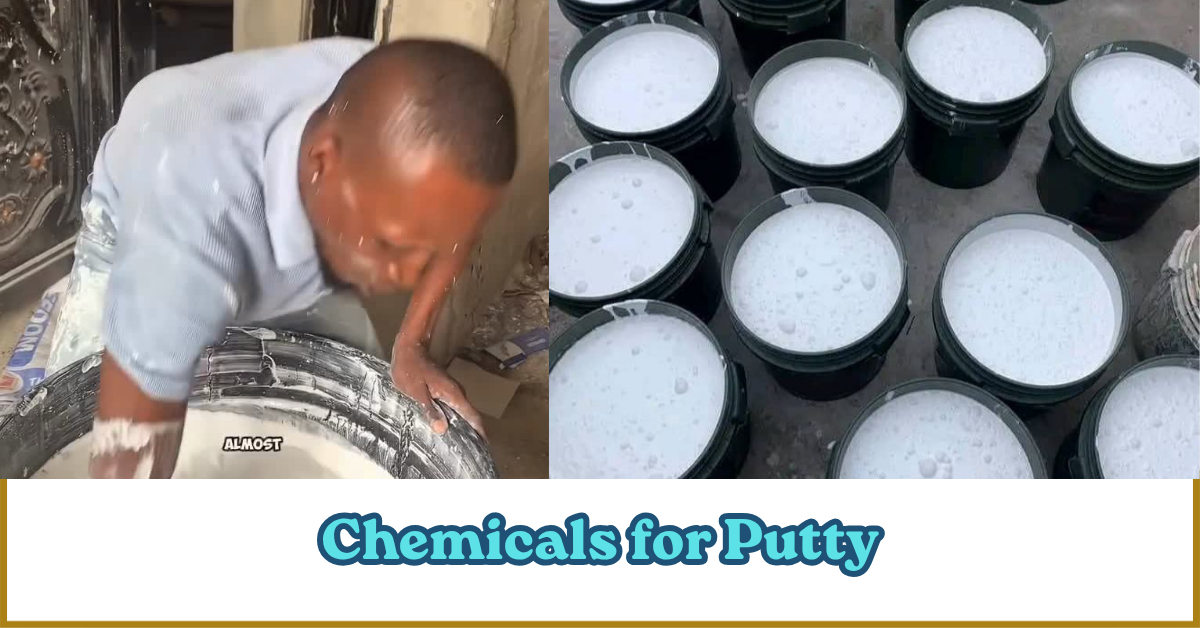
Chemicals for Putty
If you want to produce quality putty, understanding the chemicals for putty and the function of each material is important. The right combination of raw materials helps determine the texture, durability, coverage, and how solid your putty become.
Many beginners make the mistake of buying chemicals without understanding what each one does. This can lead to poor-quality putty.
In this article, you will learn the complete list of chemicals for putty, the function of each material, how they work together during production, mistakes to avoid, and what you need to understand before starting putty production.
What Is Wall Putty?
Wall putty is a surface preparation material applied to walls before (decorative) painting. It is generally used to repair rough and minor imperfections in the wall or ceiling to give it the smoothness and appearance required before painting.
A good wall putty should have enough adhesion, solid texture and the ability to provide a smooth surface when applied.
The quality of your putty depends on the quality of the raw materials, mixing process, and method used.
Chemicals for Putty and Their Functions
The chemicals and raw materials required for putty can change depending on the type of putty you want to produce.
However, the materials commonly used for putty production include calcium, Genopore, formalin, ammonia, biocide, texanol, thickener and gum.
Each material has a specific purpose, and the correct mixing process is important because adding more of a particular chemical does not automatically produce a better or quality putty.
1. Calcium
Calcium is one of the major materials used in putty production. calcium is what transform to form the body and solid content of the putty.
Proper dissolving is important during production. If the material is not properly dissolve into the mixture, the finished product may contain lumps or have a poor texture.
For this reason, calcium should be mixed thoroughly before proceeding to the next production stage.
2. Genopore
Genopore is included in the formulation, this helps to make it run easily on your screeding pan or putty knief when screeding.
It is also a preservative agent that contribute to the product not getting spoil fast.
3. Formalin
Formalin is also a preservative agent, this also help the putty to dry faster when applied on the wall or ceiling.
Its purpose is also to help protect the product against microbial spoilage during storage.
However, formalin requires careful handling. It can be hazardous, so anyone using it should follow the industry recommended standard and ensure adequate ventilation.
The quantity should be based on an appropriate formulation rather than guesswork.
4. Ammonia
Ammonia is used to help control the pH and other chemical of the mixture.
Ammonia is also use to syn other chemicals in your formulation together.
Ammonia should be handled carefully because its vapour can irritate the eyes and respiratory system. Good ventilation and appropriate protective equipment are important when working with it.
5. Thickener
Thickener is an agent use to transform your putty from that watery form to a thicker and more solid form .
It is an important component because Without an appropriate thickening system, you can’t call it putty.
The quantity of thickener required depend on the formulation and the desired quality of the putty you want to make.
6. Biocide
Biocide is an agent use to control bacteria or mould from growing in the product while in storage or use.
It is also a preservative agent.
7. Gum
This is what gives strength, adhesion and durability to your putty, it makes it to be solid, it makes it not to chalk or wash easily. you cannot make a solid or quality putty without gum.
The exact materials and quantities can differ between different types of wall putty formulations. Commercial production should therefore follow a tested formulation of industry standard rather than relying on a generic list alone. Also see: Wall Screeding Materials in Nigeria: Complete List and Prices
How the Chemicals Work Together in Putty Production
Knowing the chemicals for putty is only the beginning. The production process also matters.
The raw materials need to be applied correctly so that the finished product has a uniform texture and quality performance.
The process generally starts with preparing the water, followed by the formulation of other materials and other components.
Materials that require separate preparation should be properly prepared before being introduced into the main mixture.
Thickener, for example, may require separate preparation depending on the type being used. Adding it correctly helps prevent lumps and allows the desired consistency to develop gradually.
Why the Quality of Putty Chemicals Matters
Two manufacturers can use the same names of chemicals and still produce very different products.
The reason is that the quality and specifications of raw materials can vary.
Particle size, purity, moisture content, concentration, and storage conditions can all influence how a material performs during production.
This is why buying the cheapest chemical available is not always the best approach. See: Wall Putty vs Cement Screeding: Which Is Better Before Painting?
Mistakes to aviod When Using Chemicals for Putty
One of the biggest mistakes beginners make is using chemicals without understanding their functions.
Another common problem is measuring materials by estimation. A formulation should be measured accurately so that each batch can be reproduced consistently.
Poor mixing can also affect the finished product. Even when the correct raw materials are used, inadequate mixing can produce an uneven mixture.
Some beginners also believe that adding extra thickener, calcium, preservative, or another chemical will automatically improve the product. In reality, a formulation works as a system. See: Chemicals for Screeding Paint: Complete List and Their Functions
Safety When Handling Putty Chemicals
Some chemicals used in manufacturing require careful handling.
Use suitable gloves, maintain adequate ventilation, and keep chemical containers properly labelled.
A tested formulation and proper production procedure are safer and more reliable than trial and error.
FAQs
1. What chemicals are used for putty?
The materials discussed in this formulation include calcium, Genopore, formalin, ammonia, gum and thickener. Each material has a different role in the formulation.
2. What is the function of calcium in putty?
Calcium is the solid content and body of the formulation.
3. What does thickener do in wall putty?
Thickener transform the putty from it watery form to a thicker form. It also contributes to the desired body and workability of the putty.
4. Why is formalin used in putty production?
Formalin is used as part of the preservation agent system in formulations to help protect the product against microbial spoilage.
5. What does ammonia do in putty production?
Ammonia can help control the pH and chemical environment of putty formulation. The required quantity depends on the particular formulation.
6. Can I make wall putty at home?
Yes. Small-scale production may be possible with the appropriate equipment, raw materials, formulation, and safety procedures.
7. Is putty production profitable?
Putty production can be profitable when the manufacturer controls production costs, maintains consistent quality, identifies the right market, and builds reliable customer demand.
8. Do I need training to produce wall putty?
Yes. Proper training can make the process easier to understand and help reduce costly mistakes. Training can cover raw material selection, formulation, measurement, production procedures, quality control, and business practices.
Conclusion
Understanding the chemicals for putty is an important foundation for anyone interested in wall putty production.
Calcium contributes to the body and solid content of the formulation, Genopore and formalin can provide preservation, ammonia can help control pH, and thickener controls thickness and consistency.
However, the names of the chemicals alone are not enough to guarantee a quality product. The formulation, quantity, raw material quality, mixing procedure, safety practices, and quality control all play important roles. See More..
You can also see Paint Production Academy for practical paint production training and related manufacturing courses.

Godwin Zion is the founder of Paint Production Academy and a professional paint production trainer with over 18 years of practical experience in paint production, POP ceiling installation, construction finishing, and interior project execution. He teaches practical emulsion, acrylic Matte, and satin paint production using simplified step-by-step methods designed for homeowners, painters, engineers, property developers, artisans, and entrepreneurs. Through Paint Production Academy, he has helped students across Nigeria, Ghana, Cameroon and other part of the world learn valuable paint production skills that can reduce construction costs and create profitable opportunities.