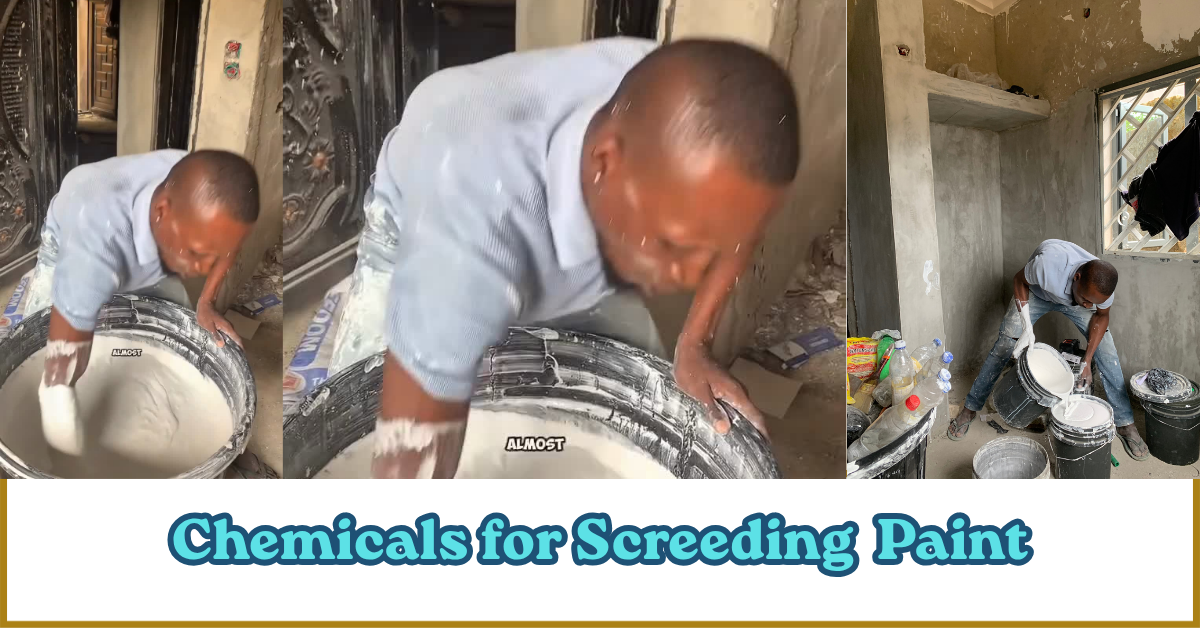
Chemicals for Screeding Paint
If you want to produce quality screeding paint, one of the first things you need to understand is the chemicals used in the production and the function of each chemical. Using the wrong material, incorrect quantity, or poor-quality raw material can affect the consistency, coverage, stability, and overall quality of your screeding paint.
The chemicals for screeding paint commonly used in the formulation include calcium, Genopore, formalin, ammonia, and thickener. Each material has a different role in the production process, and understanding these functions makes it easier to produce a consistent product.
In this article, i will explain the complete list of chemicals used for screeding paint, what each chemical does, how they are introduced during production, and some mistakes beginners should avoid.
What Is Screeding Paint?
Screeding paint is a type of paint used for surface preparation, it is use on walls, decking or Ceiling to help prepare the surface before the application premium paint.
The quality of screeding paint depends heavily on the raw materials, mixing procedure, and quality control used during production.
For anyone interested in starting a paint production business, understanding the function of each raw material is just as important as learning the production procedure.
Chemicals for Screeding Paint and Their Functions
The main chemicals and raw materials used in the screeding paint production discussed in this article are calcium, Genopore, formalin, ammonia, and thickener.
Although each material performs a different function, they must work together in the correct formulation to produce a product with the desired consistency and performance.
1. Calcium
Calcium is one of the major materials used in the production of screeding paint. It contributes to the body and structure of the paint.
When properly dissolve in water, calcium becomes part of the solid material in the formulation.
Poor dispersion can result in lumps or an inconsistent mixture.
For this reason, calcium should be thoroughly mixed before moving to the next stage of production.
2. Genopore
Genopore is used as part of the formulation to support the application of the screeding paint.
It helps the mixture achieve a suitable consistency and can contribute to how smoothly the product spreads during application.
3. Formalin
Formalin is used as a preservative in some paint formulations. Its purpose is to help protect the paint against spoilage and microbial growth during storage.
Preservation is important because paint can be vulnerable to microbial contamination when they are not adequately protected.
4. Ammonia
Ammonia is used in paint formulations to help control the chemical environment of the mixture, particularly its alkalinity and pH.
Maintaining an appropriate pH can contribute to the stability and performance of the formulation and can help the different components work properly together.
5. Thickener
Thickener is one of the important materials used to control the thickness and consistency of paint.
Without an appropriate thickening system, the product may remain too watery and may not have the desired application properties.
Complete List of Chemicals for Screeding Paint
For quick reference, the main materials discussed in this formulation are shown below.
| Chemical or Material | Main Function |
|---|---|
| Calcium | Provides body and solid material to the formulation |
| Genopore | Supports consistency and smooth application |
| Formalin | Helps preserve the paint |
| Ammonia | Helps control pH and the chemical environment |
| Thickener | Controls thickness of paint |
It is important to understand that the exact formulation can vary depending on the type of screeding paint being produced, the quality of the raw materials, and the desired characteristics of the finished product.
Why the Quantity of Each Chemical Matters
Knowing the names of the chemicals for screeding paint is not enough to produce a reliable product.
The quantity of each material matters because every component contributes to specific properties of the formulation.
Using too much thickener, for example, can produce a mixture that is excessively thick. Using too little can leave the product too thin.
This is why professional paint production involves more than simply mixing chemicals together. It requires proper formulation, accurate measurement, quality raw materials, appropriate mixing procedures, and quality control.
Mistakes to avoid
One common mistake beginners make is measuring chemicals by estimation rather than using a proper formulation.
Another problem is using low-quality or contaminated raw materials. Poor raw materials can affect the final appearance, consistency, storage stability, and application performance of the product.
Incorrectly preparing thickener is another common problem. If it is not properly dispersed before being introduced into the main mixture, lumps can develop.
Some beginners also add chemicals in random quantities because they believe that adding more material will automatically improve the paint. This is not necessarily true. Paint formulation depends on balance between the different components.
Poor mixing can also produce an inconsistent product. Even when the correct raw materials are used, inadequate mixing can prevent them from being properly distributed throughout the batch. See: How to Produce Screeding Paint
FAQs
1. What chemicals are used for screeding paint?
The chemicals and materials discussed in this formulation include calcium, Genopore, formalin, ammonia, and thickener. Each material performs a different role in the formulation.
2. What is the function of calcium in screeding paint?
Calcium contributes to the body and solid content of the formulation. Proper dissolving is important to achieve a uniform mixture.
3. What does thickener do in screeding paint?
Thickener controls the thickness and consistency of the paint.
4. What is the function of formalin in paint production?
Formalin can serve as part of the preservation system in paint formulations. It helps protect the product against spoilage caused by microorganisms.
5. What does ammonia do in paint production?
Ammonia can help control the pH and chemical environment of paint formulations. The required quantity depends on the specific formulation.
6. Can I produce screeding paint without training?
It is possible to learn the basic principles independently, but proper training can help you understand formulation, chemical measurement, mixing procedures, quality control, and common production problems more effectively.
7. Is screeding paint the same as emulsion paint?
No. Screeding paint and emulsion paint can have different purposes, formulations, properties, and production procedures. The raw materials and quantities required depend on the specific product being manufactured.
Conclusion
Understanding the chemicals for screeding paint is an important starting point for anyone interested in learning paint production.
Calcium contributes to the body of the formulation, Genopore supports the consistency and application properties, formalin can form part of the preservation system, ammonia can help control the pH, and thickener controls the viscosity of the finished product.
However, knowing the names of these chemicals is only one part of successful paint production. Correct measurement, quality raw materials, proper mixing, formulation knowledge, safety, and quality control are equally important. see: Paint Chemicals and Their Functions: Complete List for Paint Production
If your goal is to produce screeding paint commercially, learning the correct formulation and production process can help you avoid costly trial and error and produce a more consistent product.
You can also explore Paint Production Academy to learn more about practical paint production training and other paint manufacturing courses.

Godwin Zion is the founder of Paint Production Academy and a professional paint production trainer with over 18 years of practical experience in paint production, POP ceiling installation, construction finishing, and interior project execution. He teaches practical emulsion, acrylic Matte, and satin paint production using simplified step-by-step methods designed for homeowners, painters, engineers, property developers, artisans, and entrepreneurs. Through Paint Production Academy, he has helped students across Nigeria, Ghana, Cameroon and other part of the world learn valuable paint production skills that can reduce construction costs and create profitable opportunities.