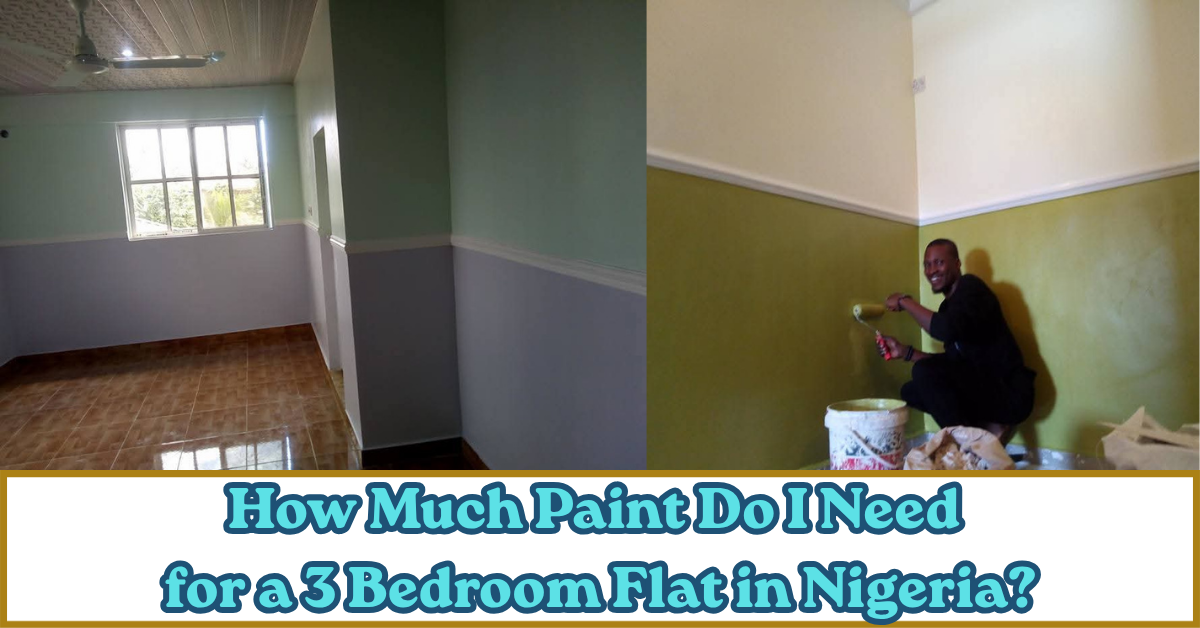
One of the first questions homeowners ask before painting a new or existing house is, “How much paint do I need for a 3 bedroom flat?“
Getting the estimate right can save you thousands of naira. Buying too little paint may delay your project and lead to colour variations if you purchase another batch later. Buying too much paint wastes money and leaves you with unused materials.
The amount of paint required for a 3 bedroom flat depends on several factors, including the size of the building, wall height, the kind of ceiling installed, the number of coats, the type of paint you want to use, and the condition of the walls. There is no single answer that applies to every house. Also read: How to Calculate Paint Quantity for House
In this article, i will share with you how to estimate paint accurately, you will understand the factors that affect paint consumption, you will be able to calculate paint quantities for different surfaces, and also avoid common estimation mistakes. If you are a homeowner, painter, contractor, or paint producer, this article will help you plan your painting project with confidence.
Why Accurate Paint Estimation Matters
Estimating paint correctly is one of the most important parts of a successful painting project.
Accurate estimate helps you: Prepare a realistic painting budget, Buy the right quantity of paint, Reduce unnecessary material waste, Avoid interruptions during painting, Maintain colour consistency by using paint from the same production batch, and if you are a painter this will help you Produce professional quotations for clients.
Professional painters rarely rely on guesswork. Instead, they measure the building carefully before purchasing paint. Also see: How to Calculate Paint Production Materials for Emulsion, Matt, and Satin Paint
There Is No Standard Quantity for Every 3 Bedroom Flat
Many people expect a fixed answer such as 100 litres or 120 litres.
In reality, every building is different because of it room sizes and ceiling height.
For example, a compact bungalow with smaller rooms requires less paint than a luxury three bedroom flat with large living areas, higher ceilings, decorative POP ceilings, and multiple corridors.
Instead of relying on assumptions, it is always better to calculate the total paintable surface area.
Factors That Affect the Amount of Paint Required
Several important factors determine how much paint you will need.
Building Size
Larger rooms have more wall and ceiling area, increasing paint consumption.
Ceiling Height
Higher walls require more paint than standard-height walls.
Number of Coats
Most professional painters apply three coats for better coverage and durability. Some colour changes or poor-quality surfaces may require four or five coat.
Type of Paint
Different paints have different coverage rates.
For example: satin paint generally covers more area other quality paints.
Acrylic matte paint has a minimum coverage rate because it is applied more thickly.
Emulsion paint have lowest coverage rate. So in a sense, the quality and the finishing you desire is directly proportion to the type of paint you choose.
Surface Condition
Newly plastered walls without screeding consume much paint, compared to walls that have been screeded or walls that have already been painted.
Average Paint Required for a Standard 3 Bedroom Flat
Although every project is unique, the following estimates are commonly used for a standard three bedroom flat in Nigeria depending on the paint type you choose.
A standard three bedroom flat (Interior) generally requires:
For Emulsion: 120 to 160 litres
For Acrylic Matte: 100 to 140 litres
For Satin: 80 to 100 litres
Ceiling Paint: 60 litres. Also see: How to Paint a POP Ceiling: Best Paint to Use
Please note, Large apartments with POP designs may require additional paint.
The exact quantity depends on wall dimensions, ceiling height, and the number of coats applied.
These figures should be treated as guides rather than fixed requirements.
The most accurate estimate comes from measuring the actual building.
Before reading further, Kindly answer 👇this question
Do you Want to Produce These Paints Yourself?

If you have ever wanted to manufacture quality emulsion, acrylic matte, and satin paints instead of buying them, this is exactly what we teach inside Paint Production Academy.
The training covers:
Professional paint formulas
Material selection
Mixing procedures
Quality control
Cost calculation
Production for small and commercial quantities
How to start a profitable paint business
Many of our students now produce paint for personal projects and commercial sales.
Learn more about the complete Paint Production Training here.
lets continue,
How to Calculate Paint for a 3 Bedroom Flat
Instead of guessing, follow these simple steps.
This steps depend on the type of paint you want to use, room sizes, wall height and the how the walls look like, if its screeded or not.
For satin: one bucket of satin can paint 2 rooms if walls are screeded or were already painted. excluding ceilings
If one bucket can paint 2 rooms, it means two more bucket can paint other remaining areas, taking the numbers to 3 bucket (60 litres).
For ceilings : i recommend you use matte (30 litres). note this ceiling estimate depends on the type of ceiling in your home.
For Acrylic matte: One bucket of matte can paint 2 rooms if walls are screeded or were already painted. excluding ceilings
If one bucket can paint 2 rooms, it means two more bucket can paint other remaining areas, taking the numbers to 3 bucket (60 litres).
For ceilings : 30 litres, note this ceiling estimate depends on the type of ceiling in your home.
For Emulsion : four bucket of emulsion can paint 2 rooms if walls are screeded or were already painted. excluding ceilings.
If four bucket can paint 2 rooms, it means four more bucket can paint other remaining areas, taking the numbers to 8 bucket (160 litres).
For ceilings : 40 litres note this ceiling estimate depends on the type of ceiling in your home.
Paint Needed for Different Parts of a 3 Bedroom Flat
Different areas of the house often require different paints.
Interior Walls
High-quality acrylic matte, or satin paint is commonly used.
Ceilings
Acrylic matte paint is a popular choice because it provides a clean, uniform finishing.
POP Ceilings
Matte paint or quality emulsion paint produces excellent results on properly done POP ceilings.
Exterior Walls
Weather-resistant Acrylic matte paint is recommended for long-lasting protection.
Metal Gates and Railings
Apply an anti-rust primer followed by a quality gloss paint designed for metal surfaces.
Common Paint Estimation Mistakes
Many homeowners underestimate the amount of paint required.
Common mistakes include: Forgetting to include ceilings, Ignoring additional coats, Not measuring the building, Assuming every room is the same size, Using incorrect paint coverage rates and Buying paint based only on previous projects.
Avoiding these mistakes helps reduce costs and give a well structured project planning.
Do you Need More Accurate Paint Estimates on a pdf format?
If you are a homeowner or a painter that regularly estimate painting projects, a manual calculator is only the beginning.
Our Paint Materials Quantification Workbook helps homeowners, paint producers, contractors, and entrepreneurs calculate the exact quantity of raw materials needed for paint production. It also allows you to scale production accurately from 1 drum to 5 drums and beyond, ensuring consistent quality while reducing material waste.
If you are producing emulsion, acrylic, or satin paint, the workbook simplifies calculations and improves production efficiency. Get workbook here.
FAQs
1. How much paint do I need for a standard 3 bedroom flat?
Most standard three bedroom flats estimation depends on the type of paint you want to use, room sizes, wall height and ceilings, require approximately 90 to 120 litres of interior wall paint.
2. How much primer is needed for a 3 bedroom flat?
Most projects require around 30 to 40 litres of primer, although the exact amount depends on the condition of the walls.
3. How many coats of paint should I apply?
Two or three coats are generally recommended for most interior painting projects because they provide better coverage, durability, and colour consistency.
4. Does ceiling paint count separately?
Yes. Ceiling surfaces should always be measured separately because they require additional paint.
5. Can one litre of paint cover an entire room?
No. Coverage depends on the room size, wall condition, paint quality, and the number of coats required.
Conclusion
Knowing how much paint you need for a 3 bedroom flat is very important for planning a successful painting project. While average estimates provide a useful starting point, the most accurate approach is to measure the building, calculate the total paintable area, and apply the correct paint coverage rate.
Taking the time to estimate paint properly reduces waste, controls costs, and ensures a smoother painting process from start to finish.

Godwin Zion is the founder of Paint Production Academy and a professional paint production trainer with over 18 years of practical experience in paint production, POP ceiling installation, construction finishing, and interior project execution. He teaches practical emulsion, acrylic Matte, and satin paint production using simplified step-by-step methods designed for homeowners, painters, engineers, property developers, artisans, and entrepreneurs. Through Paint Production Academy, he has helped students across Nigeria, Ghana, Cameroon and other part of the world learn valuable paint production skills that can reduce construction costs and create profitable opportunities.