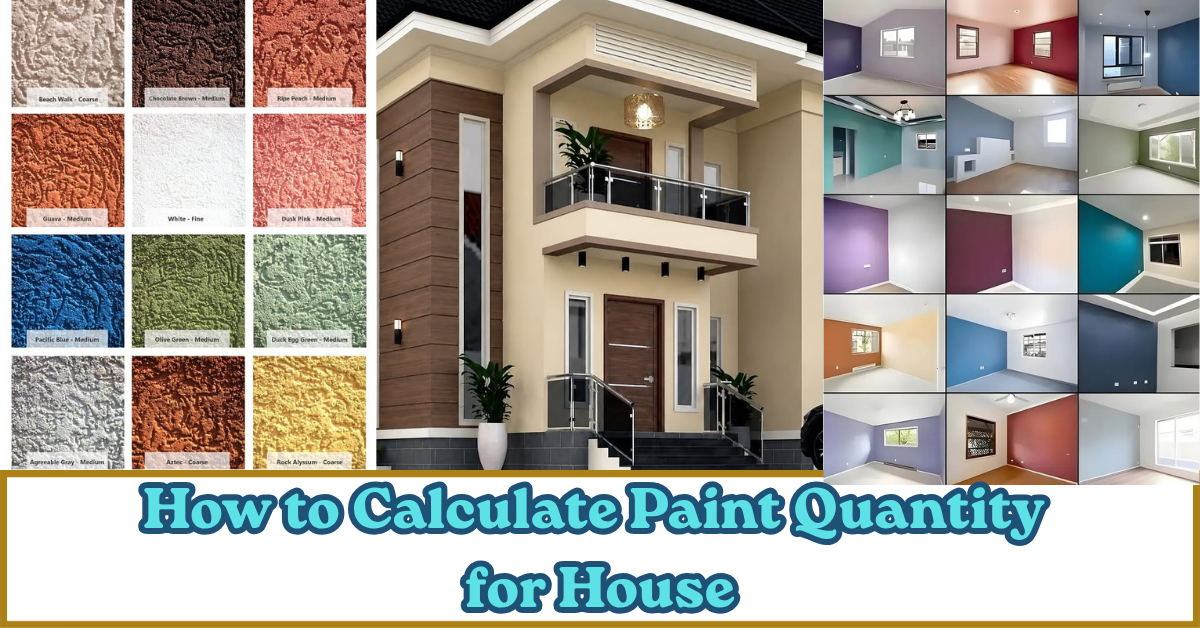
How to Calculate Paint Quantity for House
One of the biggest mistakes homeowners make when painting a house is buying paint based on guesswork. Some people purchase far more paint than they need, while others buy too little and are forced to stop work halfway through the project. Both situations waste time and money.
Knowing how to calculate paint quantity accurately helps you estimate your project cost, reduce material waste, and achieve a professional finishing. If you are painting a single room, a one bedroom apartment, a three bedroom flat, or an entire duplex, proper paint estimation allows you to buy the right amount of paint from the beginning.
For professional painters, contractors, and paint manufacturers, paint quantity estimation is an important skill. It helps prepare accurate quotations, improve customer confidence, and increase profitability.
In this article, you will learn how to calculate paint quantity for any building, understand paint coverage rates, estimate paint for different house sizes, avoid common mistakes, by using a simple formula that delivers accurate results. Also see: Best Paint for Every Part of Your House in Nigeria
Why Paint Quantity Matters
Accurate paint estimation offers many important advantages.
It prevents unnecessary spending on excess paint.
It reduces the risk of running out of paint during application.
It helps you prepare an accurate painting budget.
It allows contractors to submit professional quotations.
It minimizes material waste.
It ensures colour consistency throughout the project by purchasing sufficient paint from the same production batch.
Proper paint estimate is one of the foundations of a successful painting project. see : How to Calculate Paint Production Materials for Emulsion, Matt, and Satin Paint
Factors Affecting Paint Consumption
No two buildings require exactly the same amount of paint.
Several factors influence paint consumption.
Wall Surface Area
Larger wall areas naturally require more paint.
Surface Texture
Rough walls absorb more paint than screeded walls.
Type of Paint
Different paints have different spreading rates.
For example, satin paint often provides better coverage and spreading than others.
Number of Coats
Applying four or five coats increases the total paint consumed.
Colour Change
Changing from a dark colour to a light colour may require additional coats for complete coverage.
Surface Condition
New walls usually absorb more paint than previously painted surfaces because they are more porous.
Painter’s Technique
Experienced painters generally use paint more efficiently and produce better coverage.
Standard Paint Coverage Rates
Paint manufacturers usually indicate the estimated coverage on the product label.
Typical coverage rates are approximately:
| Paint Type | Average Coverage |
|---|---|
| Emulsion Paint | 8 to 10 square metres per 20 litres |
| Acrylic matt Paint | 60 to 80 square metres per 20 litres |
| Satin Paint | 70 to 80 square metres per 20 litre |
Note please, these figures are estimates.
Actual coverage depends on the condition of the wall and it surface preparation. Also see: How to Calculate Paint Production Materials for Emulsion, Matt, and Satin Paint
How to Calculate Wall Area
Calculating wall area is simple.
Step 1
Measure the length of the wall.
Step 2
Measure the height of the wall.
Step 3
Multiply:
Wall Area = Length × Height
For example:
Wall length = 5 metres
Wall height = 3 metres
Wall Area = 5 × 3
Wall Area = 15 square metres
Repeat the process for every wall.
Add all wall areas together.
Subtract large doors and windows if you want or you can ignore and use it as contingency for the project to have a more accurate estimate.
How to Calculate Ceiling Area
Ceiling calculation is even easier.
Use this formula:
Ceiling Area = Length × Width
Example:
Room length = 6 metres
Room width = 5 metres
Ceiling Area = 6 × 5
Ceiling Area = 30 square metres
Calculate each room separately before adding the totals.
Paint Required for a One Bedroom Apartment
The actual quantity depends on the type of paint you want to use and wall height.
However, a typical one bedroom apartment (interior) usually requires approximately:
For Emulsion: 70 to 80 litres
For Acrylic Matte: 60 to 70 litres
For Satin: 30 to 50 litres
Ceiling Paint: 30 litres. Also see: How to Paint a POP Ceiling: Best Paint to Use
Please note, Large apartments with POP designs may require additional paint.
Before reading further, Kindly answer 👇this question
Do you Want to Produce These Paints Yourself?

If you have ever wanted to manufacture quality emulsion, acrylic matte, and satin paints instead of buying them, this is exactly what we teach inside Paint Production Academy.
The training covers:
Professional paint formulas
Material selection
Mixing procedures
Quality control
Cost calculation
Production for small and commercial quantities
How to start a profitable paint business
Many of our students now produce paint for personal projects and commercial sales.
Learn more about the complete Paint Production Training here.
Lets Continue…
Paint Required for a Two Bedroom Flat
Average estimates for interior include:
For Emulsion: 100 to 120 litres
For Acrylic Matte: 90 to 110 litres
For Satin: 60 to 80 litres
Ceiling Paint: 50 litres. Also see: How to Paint a POP Ceiling: Best Paint to Use
Please note, Large apartments with POP designs may require additional paint.
Exterior painting is calculated separately.
Paint Required for a Three Bedroom Flat
A standard three bedroom flat (Interior) generally requires:
For Emulsion: 120 to 160 litres
For Acrylic Matte: 120 to 140 litres
For Satin: 80 to 100 litres
Ceiling Paint: 60 litres. Also see: How to Paint a POP Ceiling: Best Paint to Use
Please note, Large apartments with POP designs may require additional paint.
The exact quantity depends on wall dimensions, ceiling height, and the number of coats applied.
Paint Required for a Duplex
Duplexes vary greatly in size.
Many medium sized duplexes require approximately:
- Interior Paint: 150 to 250 litres (depending on paint type)
- Ceiling Paint: 40 to 70 litres
Luxury duplexes with larger rooms may require considerably more.
Always calculate actual surface areas before purchasing materials.
Common Calculation Mistakes
Many people make avoidable estimation errors.
Common mistakes include:
Ignoring ceiling areas.
Forgetting to include additional paint coats.
Using manufacturer coverage rates without considering rough wall surfaces.
Buying paint before measuring the building.
Not accounting for paint wastage during application.
Assuming every room requires the same quantity of paint.
Accurate measurements always produce better estimates.
Tip for More Accurate Estimates
Professional painters rarely estimate paint quantities using wall area alone.
They also consider:
- Surface porosity.
- Wall texture.
- Paint quality.
- Number of colours.
- Decorative features.
- Cornices.
- POP ceilings.
- Feature walls.
- Waste allowance.
These details improve estimation accuracy and reduce unexpected material shortages.
Improve Your Paint Estimation Accuracy
If you regularly produce paint, manage painting contracts, or prepare quotations, manual calculations can become time consuming and increase the risk of costly mistakes.
To make the process easier, I developed a Paint Materials Quantification Workbook that automatically calculates the exact quantity of paint chemicals required for production. It also allows you to scale production accurately from 1 drum to 5 drums and beyond, helping you maintain consistent quality while reducing material waste.
If you are a paint producer, Homeowner, contractor, or entrepreneur, the workbook simplifies material planning and saves valuable time when preparing paint for projects of any size.
FAQs
1. How do I calculate paint quantity for a house?
Measure the total wall and ceiling surface area, divide the area by the paint coverage rate, then multiply by the number of coats required.
2. How many litres of paint are needed for a three bedroom flat?
Most standard three bedroom flats require approximately 90 to 120 litres of interior paint, depending on wall dimensions, paint type, and the number of coats.
3. How much area does one litre of paint cover?
Most quality interior paints cover between 4 or 5 square metres per litre under normal conditions.
4. Should ceilings be included when calculating paint?
Yes. Ceiling surfaces should always be measured separately because they require additional paint.
5. Does primer affect paint quantity?
Yes. Applying primer reduces paint absorption on new walls and often improves the final finish while reducing overall paint consumption.
6. What factors increase paint consumption?
Rough surfaces, poor wall preparation, multiple coats, colour changes, and low quality paint all increase paint usage.
Conclusion
Learning how to calculate paint quantity accurately helps homeowners, painters, contractors, and paint manufacturers complete projects with greater confidence. Instead of relying on guesswork, accurate calculations allow you to budget properly, reduce waste, maintain colour consistency, and avoid costly interruptions during painting.
By measuring wall and ceiling areas correctly, understanding paint coverage rates, and considering factors such as surface texture and the number of coats, you can estimate paint requirements with much greater accuracy.
Taking a few extra minutes to calculate paint quantity before purchasing materials can save both money and time, making every painting project more efficient and successful.

Godwin Zion is the founder of Paint Production Academy and a professional paint production trainer with over 18 years of practical experience in paint production, POP ceiling installation, construction finishing, and interior project execution. He teaches practical emulsion, acrylic Matte, and satin paint production using simplified step-by-step methods designed for homeowners, painters, engineers, property developers, artisans, and entrepreneurs. Through Paint Production Academy, he has helped students across Nigeria, Ghana, Cameroon and other part of the world learn valuable paint production skills that can reduce construction costs and create profitable opportunities.