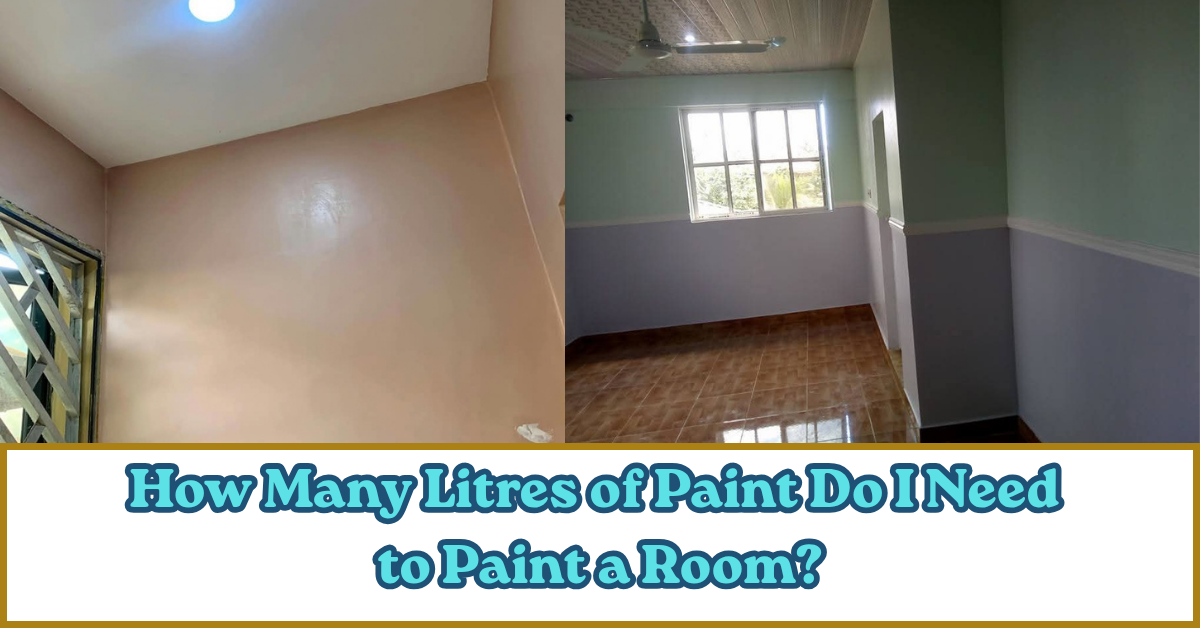
The quantity of paint required to paint a room depends on the wall measurements, number of coats, type of paint, type of surface to be painted. A small bedroom may require only a few litres, while a large sitting room with high walls will need more.
For example, a 12 ft × 12 ft room with walls approximately 3 metres high has a gross wall area of about 43.9 square metres. After deducting the doors and windows, the paintable area may be approximately 39 square metres.
If the selected paint covers 10 square metres per litre per coat, you would need approximately 7.8 litres for two coats before adding an allowance for waste and surface absorption. See How to Prepare Walls Before Painting: Tips for a Perfect Finishing
This means a 10-litre bucket could be enough to paint a 12ft x 12ft room after a good surface preparation have been done. However, paint coverage varies, so the correct quantity must be calculated using the coverage rate of the actual product. this estimate is for satin paint only.
This article explains how to measure a room, calculate the quantity of paint required and estimate the number of litres or buckets needed before painting begins.
How to Calculate the Quantity of Paint Needed for a Room
The basic paint quantity formula is:
Paint Required (Litres) = Wall Area (m²) × Number of Coats ÷ Paint Coverage (m²/L)
For example:
Wall area = 40m²
Number of coats = 2
Paint coverage = 10m² per litre per coat
Calculation:
40 × 2 ÷ 10 = 8 litres
Estimated paint quantity = 8 litres
This is the theoretical quantity before allowing for waste, wall absorption and application losses.
If you add a 10% allowance:
8 × 1.10 = 8.8 litres
You would need approximately 9 litres of paint.
The coverage rate of 10m² per litre is an example used to demonstrate the calculation. Always check the actual paint manufacturer’s stated coverage and adjust for your wall condition. See Best Paint for Interior Walls After Screeding in Nigeria
Step 1: Measure the Length and Width of the Room
Start by measuring the room using a measuring tape.
You need three measurements:
- Length
- Width
- Wall height
For example, assume a bedroom measures:
Length = 4 metres
Width = 3 metres
Wall height = 3 metres
Calculate the room perimeter:
Perimeter = 2 × (Length + Width)
2 × (4 + 3) = 14 metres
Multiply the perimeter by the wall height:
14 × 3 = 42m²
Gross wall area = 42 square metres
This represents the combined area of all four walls before deducting openings.
Step 2: Subtract the Area of Doors and Windows
Doors and windows reduce the area that needs painting.
For example, assume the room has one door measuring 0.9m × 2.1m.
Door area:
0.9 × 2.1 = 1.89m²
The room also has one window measuring 1.2m × 1.2m.
Window area:
1.2 × 1.2 = 1.44m²
Total openings:
1.89 + 1.44 = 3.33m²
Subtract the openings from the gross wall area:
42 − 3.33 = 38.67m²
Net wall area = 38.67 square metres
This is the area you will use for your paint calculation.
If the window reveals, door frames or other adjoining surfaces will also be painted, measure those surfaces separately.
Step 3: Determine the Paint Coverage Per Litre
Paint coverage tells you how much surface area one litre of paint can cover.
It is usually expressed in square metres per litre, such as 8m²/L, 10m²/L or 12m²/L.
However, different paint products have different coverage rates.
Coverage depends on the formulation, pigment concentration, application thickness, wall texture, type of surface you want to paint, porosity and application method.
For illustration, consider the following coverage scenarios:
8m² per litre: A lower-coverage planning example.
10m² per litre: A middle-range planning example.
12m² per litre: A higher-coverage planning example.
Please note These calculation scenarios, is mainly for satin paints.
If the manufacturer specifies a coverage rate, use that figure as the starting point and consider the actual condition of the surface. See Is Screeding Necessary Before Painting Walls? Everything You Need to Know
Step 4: Calculate Paint for Two Coat or Three Coats
Assume your net wall area is 40m² and your selected paint has an estimated coverage of 10m² per litre.
Paint Required for One Coat
40 ÷ 10 = 4 litres
You need approximately 4 litres for one coat before waste allowance.
Paint Required for Two Coats
40 × 2 ÷ 10 = 8 litres
You need approximately 8 litres for two coats before waste allowance.
Paint Required for Three Coats
40 × 3 ÷ 10 = 12 litres
You need approximately 12 litres for three coats before waste allowance.
The actual number of coats depends on the paint’s hiding power, the previous wall colour, the surface condition and the finishing required.
A high-quality paint with good hiding power will give good coverage with fewer coats than a lower-hiding formulation. See Why Is My Paint Not Covering Well? 9 Causes and How to Fix It
Paint Quantity for Different Room Sizes
The examples below assume:
- Wall height of 3 metres
- Two coats of paint
- Coverage of 10m² per litre per coat
- A 10% allowance for waste
- No deduction for doors or windows
These are gross-area estimates. Actual quantities may be lower after deducting openings or higher where surfaces are rough and porous.
10 ft × 10 ft Room
Gross wall area: approximately 36.6m²
Paint required: 36.6 × 2 ÷ 10 × 1.10
Estimated quantity: 8.1 litres
12 ft × 12 ft Room
Gross wall area: approximately 43.9m²
Paint required: 43.9 × 2 ÷ 10 × 1.10
Estimated quantity: 9.7 litres
12 ft × 14 ft Room
Gross wall area: approximately 47.5m²
Paint required: 47.5 × 2 ÷ 10 × 1.10
Estimated quantity: 10.5 litres
14 ft × 14 ft Room
Gross wall area: approximately 51.2m²
Paint required: 51.2 × 2 ÷ 10 × 1.10
Estimated quantity: 11.3 litres
14 ft × 16 ft Room
Gross wall area: approximately 54.9m²
Paint required: 54.9 × 2 ÷ 10 × 1.10
Estimated quantity: 12.1 litres
16 ft × 18 ft Room
Gross wall area: approximately 62.2m²
Paint required: 62.2 × 2 ÷ 10 × 1.10
Estimated quantity: 13.7 litres
These estimates are useful for initial planning. For a more accurate result, calculate the actual net wall area and use the selected paint’s coverage rate.
How Many Square Metres Does 20 Litres of Paint Cover?
To calculate the area that 20 litres of paint can cover, multiply the paint quantity by the coverage rate.
Coverage Area = Paint Quantity × Coverage Per Litre
Assume the paint covers 10m² per litre per coat.
20 × 10 = 200m²
This means 20 litres can theoretically cover 200m² for one coat.
For two coats:
200 ÷ 2 = 100m²
Theoretical coverage for two coats = 100m²
This calculation does not include waste, surface absorption or other application losses.
If you use a 10% planning allowance, the effective area for two coats would be approximately:
100 ÷ 1.10 = 90.9m²
The actual result depends on the paint and the surface. See our Paint Quantity Calculator
How Many Buckets of Paint Do I Need for a 3-Bedroom Flat?
To calculate paint for an entire interior flat, measure the walls in every room.
Please note this estimate is only for walls (satin paint), ceiling is not included.
For example, assume the net paintable wall areas are:
Sitting room = 58m²
Bedroom 1 = 40m²
Bedroom 2 = 38m²
Bedroom 3 = 38m²
Kitchen = 25m²
Passage = 20m²
Total wall area:
58 + 40 + 38 + 38 + 25 + 20 = 219m²
Assume two coats and a coverage rate of 10m² per litre.
219 × 2 ÷ 10 = 65.7 litres
Add a 10% allowance:
65.7 × 1.10 = 72.27 litres
Estimated paint quantity = approximately 75 litres
If the paint is supplied in 20-litre buckets,For example, three 20-litre buckets would provide 60 litres, while a combination of smaller containers may reduce leftover paint.
Note this example covers the internal walls only. Ceilings, exterior walls, doors and other surfaces must be calculated separately. See : Paint Chemicals and Their Functions: Complete List for Paint Production
Factors That Affect Paint Consumption
1. Wall Texture
Smooth surfaces generally allow more uniform application, while rough or textured walls have a greater effective surface area and may consume more paint.
2. Wall Porosity
Highly porous surfaces can absorb more paint, particularly during the first coat.
Proper priming or sealing may help achieve a more uniform finishing and reduce excessive absorption.
3. Number of Coats
Applying two to three coats generally requires more paint than one coat.
The required number of coats depends on the product’s hiding power, colour change and application specification.
4. Paint Quality and Formulation
Paints differ in pigment content, binder system, solids content and recommended film thickness.
These differences affect hiding power, spreading rate and the final appearance.
5. Application Method
Brushes, rollers and spray equipment can produce different levels of material loss.
Spray application may involve overspray, while poor roller technique can lead to uneven film thickness.
6. Colour Change
Painting a light colour over a dark wall may require additional preparation or coats to achieve uniform hiding.
Common Mistakes to aviod When Calculating Paint Quantity
Using Floor Area Instead of Wall Area
A room with a floor area of 13m² may have more than 40m² of wall area.
Always measure the wall height and perimeter.
Forgetting Doors and Windows
Large openings reduce the wall area that requires paint.
Measure them and subtract their combined area from the gross wall area.
Ignoring the Number of Coats
Calculating paint for one coat when the project requires two coats will underestimate the quantity.
Assuming Every Paint Covers the Same Area
Different paint formulations have different coverage rates.
Use the manufacturer’s specification for the selected product.
Forgetting the Ceiling
If the ceiling will also be painted, calculate its area separately.
For a rectangular room:
Ceiling Area = Length × Width
Then add the ceiling paint requirement to the wall paint quantity only if the same product and colour will be used.
Simple Paint Quantity Calculator
Use the following calculation for any rectangular room.
Step 1: Calculate the room perimeter
2 × (Length + Width)
Step 2: Calculate gross wall area
Perimeter × Wall Height
Step 3: Subtract openings
Gross Wall Area − Doors and Windows
Step 4: Calculate paint quantity
Net Wall Area × Number of Coats ÷ Coverage Rate
Step 5: Add an allowance
Multiply the estimated quantity by 1.10 if using a 10% planning allowance.
Example:
Room = 5m × 4m
Wall height = 3m
Openings = 5m²
Coverage = 10m²/L
Coats = 2
Perimeter:
2 × (5 + 4) = 18m
Gross wall area:
18 × 3 = 54m²
Net wall area:
54 − 5 = 49m²
Paint required:
49 × 2 ÷ 10 = 9.8 litres
Add 10%:
9.8 × 1.10 = 10.78 litres
Estimated quantity = approximately 11 litres
FAQs
1. How many litres of paint do I need for a 12 × 12 room?
For a 12 ft × 12 ft room with 3m-high walls, the net wall area may be approximately 39m² after deducting openings. At 10m² per litre per coat, two coats require approximately 8 litres before waste allowance or about 9 litres with a 10% allowance.
2. Is 4 litres of paint enough for one room?
It depends on the room size, coverage rate and number of coats. Four litres may be sufficient for a small area or a single coat, but it may not cover all four walls of a standard bedroom for two coats.
3. How many square metres does 20 litres of paint cover?
At an illustrative spreading rate of 10m² per litre, 20 litres theoretically covers 200m² for one coat or 100m² for two coats, before application losses.
4. How many litres of paint do I need for a 3-bedroom flat?
The quantity depends on the combined paintable wall area, number of coats and paint coverage. In the worked example in this guide, a flat with 219m² of net internal wall area requires approximately 75 litres for three coats, including a 10% allowance.
5. Does satin paint cover more than emulsion paint?
Yes. Because satin paint have greater hiding power than emulsion paint.
6. Should I include the ceiling when calculating paint quantity?
Yes, if the ceiling will be painted. Calculate the ceiling area separately and determine its paint requirement using the appropriate product coverage rate.
Conclusion
To calculate how many litres of paint you need for a room, first measure the wall area, subtract doors and windows, and determine the number of coats required.
Then use:
Paint Quantity = Net Wall Area × Number of Coats ÷ Paint Coverage
Add an appropriate allowance for waste and surface absorption before purchasing.
For a typical 12 ft × 12 ft room with 3m-high walls, two coats may require approximately 9 litres under the example conditions used in this guide.
Always use the coverage specification of the actual paint product and inspect the wall condition before finalizing your estimate. See more..

I am Godwin Zion With over 18 years of hands-on experience in construction finishing, I help organizations, entrepreneurs, vocational institutions, and development programs build practical skills that create jobs, improve quality, and support sustainable businesses.
My expertise combines technical knowledge with practical field experience in paint production, POP ceiling installation, wall preparation, decorative finishing, and construction finishing. I have trained aspiring entrepreneurs, skilled artisans, and business owners to produce high-quality paints, deliver professional finishing services, and build profitable businesses.
I believe practical skills create economic opportunities. My mission is to equip individuals and organizations with the knowledge, systems, and confidence to succeed in the construction finishing industry across Africa.