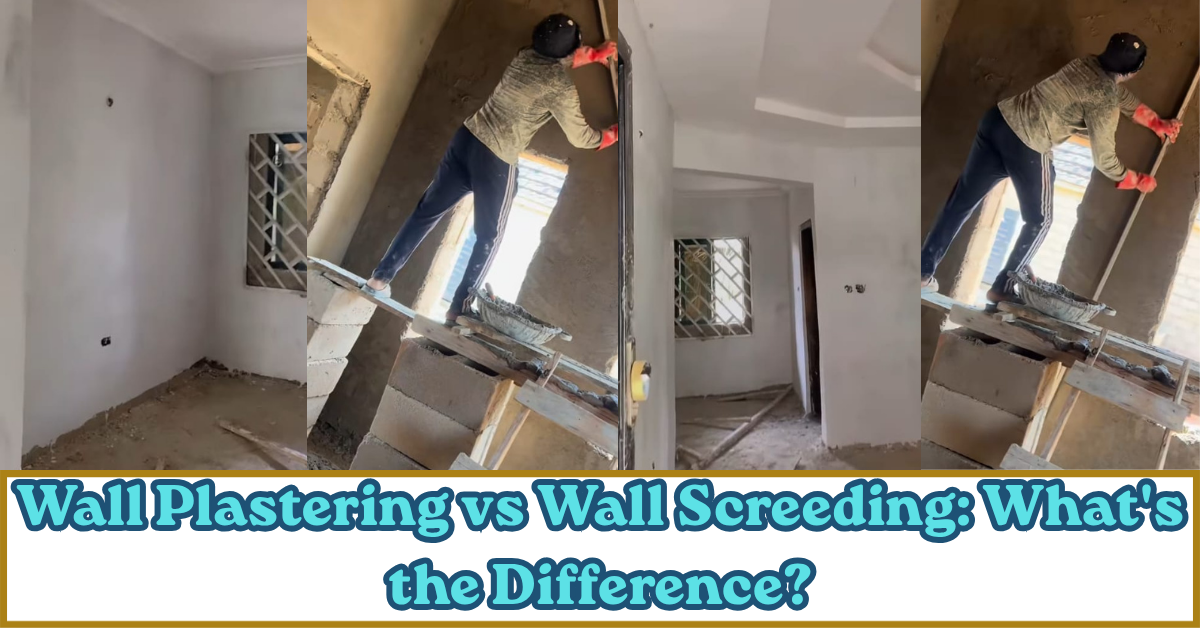
Wall Plastering vs Wall Screeding
If you are building a new house or renovating an existing property in Nigeria, you have probably heard the terms wall plastering and wall screeding. Many homeowners use these terms interchangeably, believing they refer to the same construction process. However, they serve different purposes and are carried out at different stages of building construction.
Understanding the difference between wall plastering and wall screeding is important because it helps you make better decisions about your building project, avoid unnecessary expenses, and achieve a smoother, more durable finishing before painting. Also read: Best Paint for Interior Walls After Screeding in Nigeria
Choosing the wrong finishing method or skipping an important stage can lead to rough walls, poor paint adhesion, cracks, and higher maintenance costs in the future.
In this article, i will explain what wall plastering and wall screeding are, how they differ, the materials used for each process, when they should be carried out, and which option is best for your home. Also see: Wall Screeding Materials in Nigeria: Complete List and Prices
What Is Wall Plastering?
Wall plastering is the process of covering a block or brick wall with a layer of cement mortar to create a flat, solid surface. It is one of the first finishing stages after the blocks have been constructed or layed.
The primary purpose of plastering is to protect the blocks and walls, its gives strength to the blocks and wall, and provide a level surface for further finishing.
In Nigeria, wall plastering is commonly carried out using cement, sharp sand, and clean water. These materials are mixed to form mortar, which is applied to both interior and exterior walls.
A properly plastered wall helps seal joints and holes between blocks, protects the building against weather conditions, and provides a strong and solid base for the next stage of finishing.
Although plastering makes the wall much smoother than exposed blocks, it usually does not produce the perfectly smooth finishing required before painting. That is why many buildings undergo wall screeding after plastering.
What Is Wall Screeding?
Wall screeding is the process of applying a thin finishing layer over a plastered wall to remove minor surface imperfections and create a very smooth surface before painting.
Unlike plastering, screeding is mainly a finishing process rather than a structural one.
Depending on the type of finishing required, wall screeding may be carried out using (ordinary) cement to screed, wall putty, or plaster of Paris (POP cement). The choice of material depends on the desired smoothness, budget, and the type of paint that you want to paint. Also see:How Much Does Wall Screeding Cost in Nigeria?
A well screeded wall improves paint adhesion, reduces paint absorption, and gives a good surface preperation appearance to the wall.
Many residential homes, hotels, offices, and commercial buildings in Nigeria use wall screeding to achieve a high quality interior finishing. Also read: How to Produce Screeding Paint 2026
Wall Plastering vs Wall Screeding breakdown
Although both processes involve applying materials to a wall, they perform different functions during construction.
| Feature | Wall Plastering | Wall Screeding |
|---|---|---|
| Purpose | Creates a solid and strong level wall surface | Creates a smooth finishing and prepare surface before painting |
| Stage of construction | After block work | After plastering |
| Thickness | Relatively thick layer | Thin finishing layer |
| Common materials | Cement, sharp sand and water | (ordinary) Cement, wall putty or POP cement |
| Main function | Strength and protection | Smoothness,wall preparation and appearance |
| Suitable for | Interior and exterior walls | Mostly interior walls |
| Ready for painting | Usually requires further finishing | Designed to prepare walls for painting |
This comparison makes it easier to understand that plastering and screeding complement each other rather than replace one another. Also see: Best Paint for Every Part of Your House in Nigeria
Key Differences Between Wall Plastering and Wall Screeding
The biggest difference lies in their purpose.
Wall plastering is intended to make the wall solid and give it strength, it also level the wall after blocks construction or laying. It covers block joints and holes, fills large gaps, and prepares the wall for other stage of finishing.
Wall screeding is intended to refine the plastered surface. It covers small rough imperfections, fills tiny holes, and give the wall a good surface preperation before painting as expected in modern homes.
Another difference is the thickness of application.
Plastering is applied in a much thicker layer because it must correct and cover the blocks properly.
Screeding is much thinner because it is designed to prepare the wall surface of an already plastered wall rather than reshape it.
The materials used also differ.
Plastering relies mainly on cement mortar made from cement, sharp sand, and water.
Screeding, you may use cement and paint to screed, or wall putty, or plaster of Paris (POP cement) and paint to screed depending on the finising you desire.
The finishing appearance also varies significantly.
A plastered wall often feels slightly rough and may still contain minor surface imperfections.
A properly screeded wall feels noticeably smoother and is ready for painting after adequate drying.
Paint performance is another major difference.
Applying paint directly to plastered walls may require more paint because the surface absorbs more moisture and remains less uniform. See: How Much Is Interior Paint in Nigeria
Screeded walls generally require less paint, and produce a cleaner surface finishing because the surface is smoother and better prepared. Also read: Labour Cost for Painting Work in Nigeria
Materials Used for Wall Plastering and Wall Screeding
Although both processes involve wall finishing, the materials used are not exactly the same.
Wall plastering usually requires ordinary cement, clean sharp sand, clean water, and, where necessary, additives that will make wall more durable.
Wall screeding depends on the type of screeding you want to do.
Cement screeding commonly uses cement, screeding paint, Acrylic gum and water seal to produce a smoother surface preparation than ordinary plaster.
Wall putty screeding uses already mixed or formulated wall putty specifically for interior finishing.
POP screeding uses plaster of Paris (POP cement), screeding paint, and Acrylic gum to produce smooth surface preparation finishing making it ready for painting.
Using quality materials at each stage contributes to stronger and solid walls, better paint performance, and a more attractive finished building.
Which Comes First, Plastering or Screeding?
Plastering always comes before screeding.
After the block work has been completed, the walls are plastered to create a level and durable surface.
Once the plaster has been done properly and any defects have been corrected, screeding is applied to smooth the wall further and prepare it for painting.
Attempting to screed an unplastered block wall is not recommended because screeding is not designed to replace plastering. Its purpose is to improve an already plastered surface rather than provide structural strength.
Following the correct sequence helps ensure a durable wall finishing and reduces the likelihood of cracks, poor paint adhesion, and uneven surfaces later in the project. See: How to Repair Cracks in a POP Ceiling
When Should You Choose Wall Plastering?
Wall plastering is necessary for almost every new building because it forms the foundation for all other wall finishing. After the block work is completed, plastering is used to cover blocks and joints, it is also use to straighten the wall, and create a solid surface that can withstand years of use.
You should choose wall plastering if you are constructing a new house, renovating walls that have suffered major damage, or repairing surfaces with deep holes and rough block work. It is also important for exterior walls because it protects the building from weather conditions and improves the strength of the wall.
Without proper plastering, the wall will remain rough and unsuitable for painting or decorative finishing.
When Should You Choose Wall Screeding?
Wall screeding should be carried out after plastering has completely dried and cured. It is the ideal choice when you want perfectly smooth walls before painting.
Modern residential homes, hotels, offices, shopping complexes, and luxury apartments often include wall screeding because it produces a cleaner and more attractive finishing.
If your goal is to achieve best paint results with fewer visible imperfections, screeding is highly recommended.
Can You Paint Directly After Plastering or Screeding?
Yes, it depends on individual preference if you don’t have the budget for screeding you can paint directly on plastered walls, using Acrylic matte paint but it is generally not recommended if you want a professional finishing.
Freshly plastered walls are usually rough and porous. Applying paint directly to them often results in excessive paint absorption.
For the best results, plastered walls should first be screeded, allowed to dry completely, it must be sanded where necessary, and then coated with a quality primer before the paint is applied.
Screeded walls provide a much better surface for painting because they are smoother and require less paint to achieve full coverage.
Regardless of if the wall has been plastered or screeded, adequate drying time is important before painting begins.
Common Mistakes Homeowners Make
One of the most common mistakes is assuming that plastering and screeding perform the same function. This misunderstanding often leads to poor construction decisions.
Some homeowners skip screeding in an attempt to reduce costs. While this may save money initially, the final paint finishing often reveals rough surface imperfections that could have been corrected easily.
Another common mistake is applying screeding materials before the plaster has dried properly. This increases the risk of cracks, weak bonding, and future repairs.
Using poor quality materials is another problem. Inferior cement, sand, or finishing products can affect the strength and appearance of the wall.
Painting too early is also a frequent mistake. Walls should always be allowed to dry completely before primer and paint are applied.
Finally, hiring inexperienced artisans can result in poor finishing, excessive material waste, and poor workmanship that becomes expensive to correct later.
FAQs
1. What is the difference between wall plastering and wall screeding?
Wall plastering is done to cover structural block work and creates a strong, solid and level surface walls, while wall screeding prepare the plastered surface for painting.
2. Is wall screeding necessary before painting?
For best finishing, yes. Screeding removes minor and rough imperfections, improves paint adhesion, and gives a good surface preparation to the wall making it ready for painting.
3. Can I paint directly on a plastered wall?
Yes. it is possible, if you have limited budget, but use Acrylic matte paint. however it is generally better to screed and prime the wall first. The result is less paint consumtion, better coverage, improved durability, and a more attractive finishing.
4. Which comes first, plastering or screeding?
Plastering always comes first. Screeding is carried out after the plaster has dried properly.
5. Can wall screeding replace plastering?
No. Screeding is a finishing process and cannot replace plastering. Plastering provides the structural base, while screeding refines the surface.
6.Which is more expensive, plastering or screeding?
The total cost depends on the project size and materials used. Plastering usually consumes more materials, while screeding finishing may also increase project costs. Both processes should be viewed as complementary rather than competing stages.
7. Can exterior walls be screeded?
No. but if you must screed external wall, i recommend you do wall retainers using tiles, this means fixing wall tiles from the ground to maybe window level before screeding, this will help the screeding to be durable and last for years.
Conclusion
Although wall plastering and wall screeding are closely related, they are not the same process. Plastering provides the strength and foundation needed after block work, while screeding creates the smooth wall surface preparation required for best paint finshing.
Understanding the difference helps homeowners, builders, and property developers make informed decisions, avoid costly mistakes, and achieve better construction results.
For most modern homes in Nigeria, the best approach is to complete both stages correctly. A properly plastered wall followed by quality screeding creates the ideal surface for paint, resulting in smoother walls, improved paint durability, and a more attractive interior.

Godwin Zion is the founder of Paint Production Academy and a professional paint production trainer with over 18 years of practical experience in paint production, POP ceiling installation, construction finishing, and interior project execution. He teaches practical emulsion, acrylic Matte, and satin paint production using simplified step-by-step methods designed for homeowners, painters, engineers, property developers, artisans, and entrepreneurs. Through Paint Production Academy, he has helped students across Nigeria, Ghana, Cameroon and other part of the world learn valuable paint production skills that can reduce construction costs and create profitable opportunities.